

Monica is a Marketing Manager at Frontline Data Solutions. She has a background in warehouse operations and bachelor’s degrees from Indiana University in both Supply Chain Management and International Studies.
Summary
Most safety professionals associate the management of change process with OSHA’s Process Safety Management (PSM) standard. PSM makes MOC a formal requirement for facilities that handle highly hazardous chemicals above threshold quantities, and OSHA actively enforce those requirements. But treating MOC as a PSM-only obligation is one of the most common and costly blind spots in industrial safety programs today.
In episode 142 of the Amplify Your Process Safety podcast, our CEO Ren Lu You joined host Rob Bartlett to discuss exactly this gap: why the discipline behind a formal management of change process delivers real operational and safety value even if you’re not required to follow it.
This post explains what a management of change process is, why it matters even without a PSM requirement, where programs break down in practice, and what safety leaders can do to build a process that holds up under pressure.
Key Takeaways for Safety Managers and EHS Leaders
- A management of change process is required under OSHA’s PSM standard, but the risk it addresses exists in virtually every industrial operation. Facilities outside PSM coverage face the same incident exposure with unmanaged changes.
- Teams that implement MOC for PSM-covered processes consistently find that the it positively impacts their non-covered operations once they experience it firsthand.
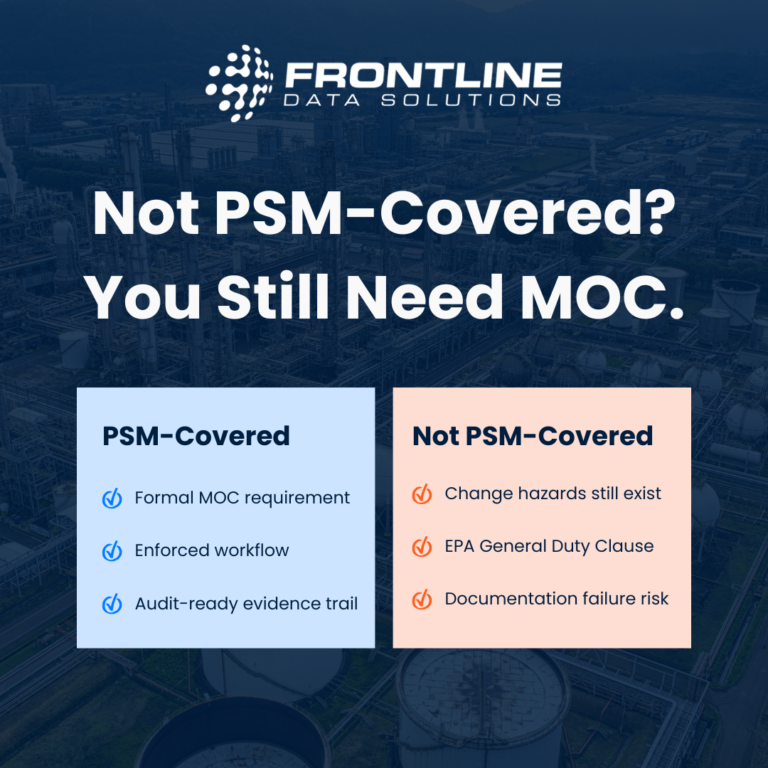
- OSHA’s General Duty Clause and the EPA’s General Duty Clause create meaningful enforcement exposure for non-PSM facilities that experience incidents following unmanaged change.
- The most common MOC failures aren’t gaps in knowledge or intent. They’re gaps in documentation, process consistency, and accountability.
- A practical MOC program for a non-PSM facility doesn’t require a PSM-level system. It requires clear triggers, defined ownership, documented hazard review, and a closed-loop process that produces defensible evidence.
What is a Management of Change Process?
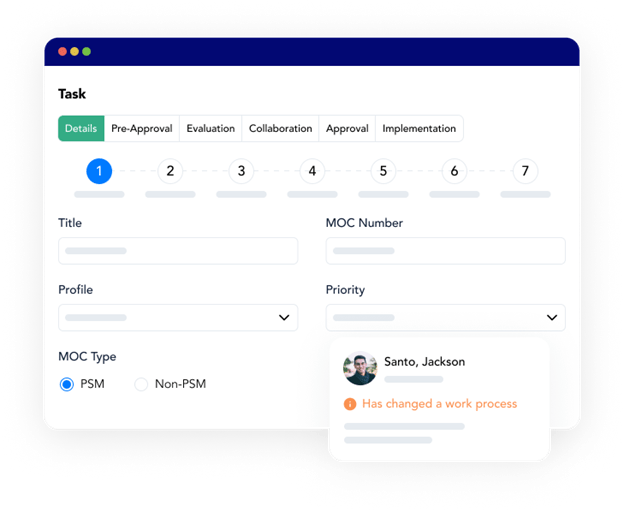
A management of change process is a system for evaluating, approving, coordinating, implementing, and documenting changes to operations, processes, equipment, procedures, or personnel before they go into effect. The purpose of an MOC process is to ensure that you carefully review and manage changes that might introduce new hazards or disrupt existing controls.
MOC is an end-to-end process that starts when someone recognizes the potential need for a change. It goes all the way through hazard review and approval, training, verified implementation, and documented closeout.
The core steps are consistent whether you operate under the PSM standard or not.
- Determine whether the change requires a formal MOC review.
- Document the nature of the change, the affected systems or personnel, and the associated hazards.
- Review and approve the change with the appropriate technical, safety, and operational stakeholders.
- Communicate the change and any updated procedures or controls to affected workers, supervisors, and contractors.
- Confirm training completion is and ensure controls are in place before the change goes into effect.
- Verify implementation and close out the record with supporting evidence.
Where MOC Starts Providing Benefits Beyond PSM
OSHA’s PSM standard applies to facilities that handle specific highly hazardous chemicals above defined threshold quantities. For covered facilities, OSHA explicitly and actively enforces MOC requirements. The reason the standard exists is because there were a series of major process safety incidents that proved changes need stricter control and oversight in highly hazardous processes.
Most industrial workplaces aren’t covered under the PSM standard. Facilities that process food, manufacture building materials, manage utilities, operate in pharmaceuticals, or run general industry operations are typically not PSM-covered. Even so, all of them experience operational change. They all introduce new equipment, modify procedures, restructure roles, add contractors, and update processes.
This is the gap that Ren Lu You described on the Amplify podcast when discussing Frontline’s management of change software users. According to him, oftentimes PSM-covered facilities find that the rigorous management of change process helps with non-PSM changes “even if it doesn’t have to be the same workflow.”
That observation captures the gap precisely. For most teams, the discipline required within the MOC process has value regardless of regulatory requirements. Companies that recognize this earliest tend to build the strongest programs.
Regulatory Risk for Non-PSM Facilities Without a Management of Change Process
The absence of a PSM obligation doesn’t eliminate regulatory exposure when unmanaged change contributes to an incident. Rob Bartlett addressed this directly on the podcast:
“EPA has what they call a general duty clause. And EPA’s general duty clause says that if you have an extremely hazardous substance, you have to manage it safely to protect people, environment, all that stuff. And that includes managing the hazards of managing change. MOC is just nowadays seen as best practice for industry for preventing [and] for keeping facilities safe.”
OSHA’s General Duty Clause, Section 5(a)(1) of the Occupational Safety and Health Act, carries similar weight. It requires employers to provide a workplace free from recognized hazards that are causing or likely to cause death or serious physical harm. OSHA has used the General Duty Clause to cite facilities for process safety failures even where no specific standard applied, and the absence of a systematic change management process has been part of that enforcement record.
When an incident occurs, OSHA’s investigation will examine what changed in the period leading up to the event. If a process was modified, equipment replaced, or a procedure updated, the investigation will ask whether that change was identified, reviewed, and controlled. If the answer is no, the absence of a process becomes part of the incident record, often contributing to citation severity and penalty calculation.
Free Download
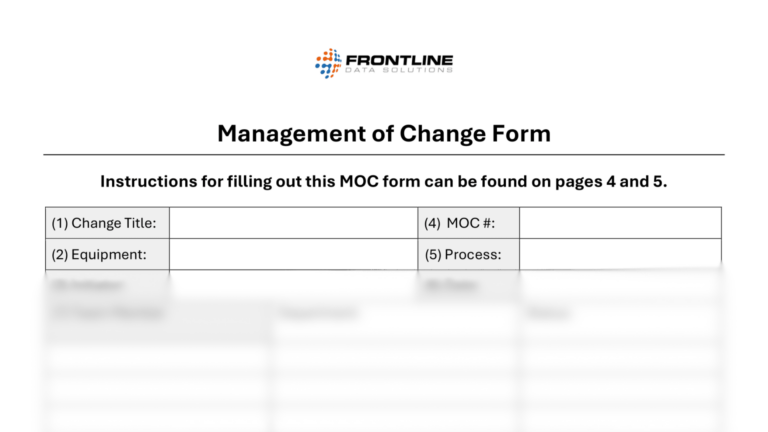
This free resource is a great first step towards formalizing your MOC process.
Why PSM-Covered Companies Expand MOC Beyond Covered Processes
One trend we’re seeing at Frontline is that companies following MOC for PSM-covered processes are applying it to other areas of their business.
Consider this example from Ren Lu You on how Frontline users apply MOC outside of process safety.
One of our clients is one of the largest dairy producers in the US. They use Frontline MOC software to manage product changes for things like yogurt and different types of milk. Packaging, recipes, and production lines are just some of the variables they account for. Following the management of change process allows them to avoid cross-contamination, production disruptions, packaging mistakes, and any other issues that pose risk to the business.
This example shows that there’s a need for MOC discipline in any operation where changes carry risk and might skip proper review channels.
ODE’s MOC Success Story
Learn how ODE Asset Management improved efficiency with Frontline MOC software.
Why the Management of Change Process Breaks Down in Non-PSM Environments
Non-PSM facilities that have some form of change management often find that it works inconsistently, that documentation is incomplete, or that the process is more of an administrative obligation than a genuine control.
Lack of Formality Creates a Lack of Urgency
Without a regulatory mandate that specifically names MOC as a requirement, the process competes against everything else on a safety team’s plate. It gets deprioritized when operations are busy and abbreviated when the change seems routine. Over time, this creates a culture where MOC happens when there’s time rather than before every change that carries risk.
Paper-Based and Fragmented Systems Can’t Enforce Consistency
Rob Bartlett noted on the podcast that many facilities still manage MOC on paper, making it nearly impossible to maintain the evidence trail that an audit or investigation requires. On the benefits of digital MOC management:
“To be able to bring up all of your MOCs right there, you click on it and there’s the information that describes it and it meets all your PSM requirements because that’s how you set it up. You have all of your action items, and you can see that action item was completed on such and such a date by such and such person. That is invaluable as somebody who has been through audits and had to scramble to try to figure out what happened. [For example] that P&ID was supposed to be updated? Apparently, that got lost because it never actually got on anybody’s to-do list.”
The same dynamic applies to systems based on spreadsheets or Word docs. They may capture information, but they rarely enforce the workflow steps that make MOC effective. Not to mention, they don’t actually save much time. Teams still dig for the right documentation and keeping everything organized requires considerable effort.
Unclear or Unenforced MOC Process Triggers
MOC programs consistently fail at step one: deciding what requires a formal review. If you don’t have clear criteria for what qualifies, then you most likely won’t follow the process very often. Important changes might slip through the cracks while insignificant ones waste time and resources. One of the easiest ways to improve your management of change process is to make the trigger for a formal review very clear to your team.
Skipped Closeout and Training Steps
Another common MOC process failure is skipping the final steps to confirm training completion and verify control measures. When your team gets busy, they’re more likely to rush or fully skip those steps. This leads to workers operating in a changed environment with no documented awareness of what’s different or which new hazards are present.
The Real Cost of Optional Management of Change
The cost of an absent or inconsistent MOC process is something we encounter often as an MOC software provider. As Ren put it:
“With MOCs, we’ve seen that folks that implement a rigorous MOC process that’s well organized and is fluid are able to complete changes more quickly…If you are installing equipment that’s going to yield a higher throughput in your process, well now the higher throughput is operational sooner than it would have been otherwise. That has a dollar benefit associated with it, but it’s a little bit hidden.”
The same principle operates in reverse. Unmanaged change creates costs that are equally significant but often not viewed as the result of a lack of change management. They show up as incidents, rework, delayed corrective actions, audit findings, and scrambles to produce evidence that doesn’t exist in the proper format.
| Cost Category | What It Looks Like in Practice | How an MOC Process Reduces It |
|---|---|---|
| Operational costs | Rework, unplanned shutdowns, and delays caused by problems that an MOC process hazard analysis would have caught | Identifies downstream effects and required controls before they become operational failures |
| Compliance and audit costs | Inability to produce complete MOC records on demand, documentation gaps, and repeat findings across audit cycles | Centralizes evidence and closes the documentation loop so records are complete and accessible |
| Incident and enforcement costs | OSHA citations under the General Duty Clause, increased penalty severity, and enforcement action following incidents tied to unmanaged change | Creates a documented record demonstrating systematic hazard control from change |
| People and productivity costs | Workers and contractors operate in a changed environment without awareness of new hazards or updated procedures | Enforces communication and training completion as a required step before changes go live |
What an Effective Management of Change Process Looks Like
A management of change process should reliably accomplish what MOC is designed to do: ensure that your team evaluates, approves, coordinates, implements, and documents every change that could introduce a new hazard or disrupt an existing control before it goes into effect.
Ren Lu You described how Frontline approaches this calibration for organizations at different hazard levels:
“Our tools are built in a way that you can pick and choose how much rigor you want, how many checks, how much redundancy. But once you’ve chosen it, it will help you enforce it. You don’t have to copy and paste everything from a high-hazard environment. You take some of the discipline from a higher hazard environment to a lower hazard environment.”
There are five elements every management of change process needs to work
- Written trigger criteria
- Defined ownership at every step
- Substantive hazard review
- Documented training before implementation
- Verified closeout with evidence
Written Trigger Criteria
You need to have a clear, written definition of what requires a formal MOC review versus a routine operation or replacement in kind. This definition should be specific enough that supervisors and managers who encounter change decisions in the field can apply it consistently.
Defined Ownership at Every Step
Each step in your MOC process (initiation, hazard review, approval, training and communication, and closeout) should have a specific role responsible for completing it. Undefined ownership means that steps default to whoever’s available, producing inconsistency across sites, shifts, and personnel.
Substantive Hazard Review
Hazard review is the analytical core of MOC. It should address any new hazards the change introduces, which existing controls may be affected, and any procedure or training modifications you’ll need. During an audit or investigation, you won’t be able to defend generic entries where your team found no new hazards and didn’t document their supporting analysis.
Documented Training Before Implementation
Affected workers, supervisors, and contractors must receive documented training or communication about the change before it takes effect. Training records should reflect who received training, the topic of the training, when it happened, and who delivered it.
Verified Closeout with Evidence
You should only close an MOC when you’ve completed implementation and:
- Confirmed that controls are in place
- Updated your procedures
- Documented training as complete
Without a closeout step, the MOC record is incomplete regardless of how thorough the review was.
What You Can Do in the Next 30 Days to Strengthen Your MOC Program
Improving a management of change process doesn’t require rebuilding your safety program. To start, simply identify the specific points where your current approach is inconsistent or undocumented. Then, start addressing them in sequence.
Week 1: Audit Your Last 5-10 Change Records
Pull the most recent change records from your program and evaluate them against your written procedure. Are hazard analyses substantive? Are training records complete and dated before implementation? Are closeout steps documented? The gaps you find are a reliable map of where the process is actually failing.
Week 2: Define and Document Your Trigger Criteria
Write down, in specific terms relevant to your operation, what constitutes a change requiring formal MOC review and what does not. Share it with supervisors and managers who make change decisions in the field. If different people reach different conclusions applying the same criteria, make the criteria more specific.
Week 3: Assign Ownership and Standardize Your Workflow
Map each MOC step to a specific role and document the expected completion sequence and timeline. Use a single, standardized form for all MOC reviews. Standardization makes the process consistent across personnel, so you can easily review it during an audit.
Week 4: Run a Mock Audit Request Exercise
Ask whether you could produce a complete, organized documentation package for a specific change from the past 12 months if OSHA or an insurer requested it tomorrow. Time the exercise. Document where your team has gaps and what (if any) evidence is missing. Doing this exercise will give you more insights than a sit-down meeting.
How Frontline MOC Supports Management of Change Programs
At Frontline Data Solutions, we focus on helping safety teams reduce operational friction in compliance and execution. For management of change, that means providing a centralized workflow for MOC initiation, hazard review, approval, training documentation, and verified closeout. This approach provides an evidence trail that makes programs defensible under audit, investigation, and enforcement pressure, regardless of whether their operation falls under PSM.
To learn more or to see how a digitized MOC workflow compares to your current process, check out our products page or request a demo with our sales team.