

Monica is a Marketing Manager at Frontline Data Solutions. She has a background in warehouse operations and bachelor’s degrees from Indiana University in both Supply Chain Management and International Studies.
Summary
Highly hazardous processes like chemical manufacturing, oil refining, and ammonia refrigeration can cause major process safety incidents and operational failures. That’s why OSHA requires these operations to have a management of change (MOC) process in place. MOC is the framework for assessing potential changes and carefully implementing them.
When MOC gaps like missing reviews, unclear decisions, etc., creep in, though, there’s a cost to your operation. Whether it’s a regulatory fine, unexpected downtime, or catastrophic incident, you can almost always trace a cost back to unmanaged changes.
This post explores why MOC compliance gaps are so costly, what the most common gaps look like in the U.S., and how to build an MOC program that holds up under real operational pressure.
What gaps are in your MOC process?
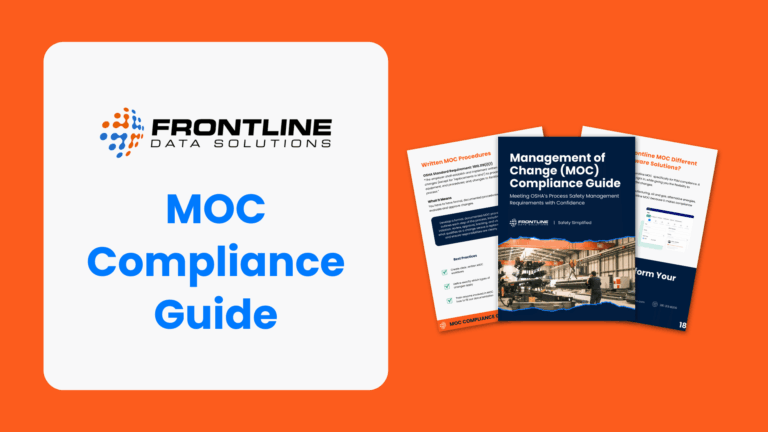
Follow our helpful MOC compliance guide and find ways to improve your program.
Key Takeaways for Safety and Operations Leaders
Change itself isn’t what hurts companies; it’s uncontrolled change that increases risk and creates cost. This is especially true when they can’t prove what changed, why it changed, who reviewed it, and how it impacted the risk profile.
MOC compliance gaps are so costly because they:
- Increase citation exposure under OSHA PSM and related requirements
- Burn potentially hundreds of thousands of dollars per hour in operational downtime
- Raise the probability of high-consequence incidents that permanently change a company’s trajectory
If you want management of change to pay for itself, don’t measure it by how many forms your team completes. Measure it by how many unmanaged changes never make it to the field and how many costly surprises don’t happen.
What Does MOC Compliance Require in the U.S?
In the United States, MOC compliance is one of the elements of PSM, or process safety management. This is OSHA standard 29 CFR 1910.119(l) which aims to prevent highly hazardous chemical releases. It outlines requirements for documenting, assessing, and monitoring operational changes to things like equipment or PSM-covered processes.
This standard requires companies to establish and implement written procedures to manage changes. It has an exception for “replacement in kind,” which is a change that meets the original design requirements of the equipment, process, or system, bypassing the need for a full hazard analysis. Written procedures should ensure that teams address these things before a change goes into effect:
- The technical basis for the change
- The impact on safety and health
- Updates needed to operating procedures
- Time period for the change (especially for temporary changes)
- Authorization requirements
- Training requirements for impacted employees
The EPA Risk Management Program (RMP) also includes expectations for accident prevention programs, inspections, and evolving requirements.
How Do MOC Compliance Gaps Create Risk?
Management of change isn’t just a paperwork exercise for OSHA. If you do it right, it’s a risk control process that prevents three expensive types of operational failures:
- Invalidated safeguards: This happens when a control strategy that was adequate yesterday becomes inadequate today because a change altered the hazard.
- Outdated procedures: This happens when operators, maintenance, or contractors follow a procedure that hasn’t been updated since a change occurred.
- Forgotten temporary changes: This happens when no one follows up on temporary changes and the hazard profile of the equipment, process, etc., shifts over time.
OSHA compliance guidelines emphasize that change includes modifications beyond obvious equipment replacements, and companies should review those changes before implementation.
Meanwhile, the U.S. Chemical Safety Board (CSB) has been blunt for decades that a lack of systematic management of change repeatedly contributes to serious incidents. This is so much the case that the CSB now has its own MOC safety bulletin and related materials.
Regulatory Citation Costs for Violations
OSHA assesses penalties per violation, not per inspection, and MOC failures rarely occur in isolation. A weak MOC process often creates gaps in related PSM elements like operating procedures, training, process safety information (PSI), pre-startup safety review (PSSR), mechanical integrity, and incident investigation.
For violations assessed after January 15th, 2025, OSHA’s posted maximum penalties are:
| Type of Violation | Penalty |
|---|---|
| Serious or Other-Than-Serious | $16,550 per violation |
| Failure to Abate | $16,550 per day beyond the abatement date |
| Willful or Repeated | $165,514 per violation |
Even if OSHA reduces your eventual settlement for these violations, the initial exposure can be substantial if an incident triggers an inspection or if the site has prior history.
Another hidden cost to consider is repeat violation findings. Once an OSHA inspector identifies that your MOC system isn’t reliable, future compliance failures become easier to characterize as repeated or willful.
Unplanned or Prolonged Downtime Costs
Don’t make the mistake of categorizing MOC as strictly a safety framework. Operations teams experience MOC compliance gaps in the form of downtime, rework, and startup delays.
Industry surveys regularly report wide ranges, but according to a report from ABB and Sapio Research, many leaders estimate that unexpected interruptions cost anywhere from $10,000 up to $500,000 per hour depending on sector and scale.
Even average manufacturing downtime estimates land in the hundreds of thousands per hour (and can be much higher in oil & gas, chemicals, and high-volume operations).
When MOC compliance gaps exist, here are some scenarios that create operational delays:
- Changes that should have taken hours take days because the team must backfill hazard review, documentation, and approvals after problems emerge.
- Startups fail because no one updated process procedures or received training.
- Quality or reliability issues force a shutdown because no one validated the technical basis for the change.
- A bypass or temporary change creates abnormal conditions that damage equipment.
Costly Safety Incidents and Injuries
The CSB exists because major incidents keep happening, and many of them involve breakdowns in management systems, not just frontline worker errors.
For example, volume 3 of its incident report shows how dozens of chemical incidents collectively resulted in hundreds of millions to billions of dollars in property damage, alongside fatalities and serious injuries. The CSB’s materials have long highlighted that a single major accident can be measured in billions when you include lost profit from shutdowns.
No two incidents are identical, but the pattern repeats:
- A change occurs.
- Hazard controls don’t keep up.
- The company’s model of risk diverges from reality.
- The system fails.
Most Common MOC Compliance Gaps in the U.S.
There isn’t an official OSHA list of the top MOC compliance gaps. But across OSHA requirements, enforcement guidance, and CSB learnings, the most common gaps tend to come from these similar issues and oversights.
Replacement in Kind Becomes a Loophole
The PSM standard allows changes without formal MOC when they are truly a replacement in kind, but many teams treat that phrase as a shortcut. Here are some examples of what that looks like:
- Replacing equipment with something that fits but has dissimilar materials, tolerances, failure behavior, or vendor specs
- Swapping instruments, sensors, or control logic without recognizing the safeguard is part of the risk model
- Treating the same model number as proof of equivalence without validating service conditions for the replacement part
This MOC compliance gap is costly because it creates undocumented drift in the process design basis. Over time, safeguards no longer match hazard analysis or procedures.
Temporary Changes Informally Become Permanent
OSHA’s MOC requirements explicitly include handling time periods for changes, which matters most for temporary modifications. Typical examples of temporary changes include things like temporary piping reroutes, bypassed interlocks, defeated alarms, and more.
Temporary changes are costly because they compound risk when teams normalize them, and the site loses track of which control measures are in place for each hazard.
The Technical Basis is Weak or Nonexistent
The MOC requirement to address the technical basis of a change is where engineering rigor belongs. MOC failures here include:
- No defined problem statement
- No design basis update
- No review of failure modes or new hazard scenarios
- No management of vendor changes or obsolescence
Without a strong technical basis, you get reliability issues, quality deviations, repeated maintenance, and eventually incidents that cost your team.
Process Safety Information (PSI) and Operating Procedures Aren’t Updated
OSHA’s PSM framework is interdependent. When changes occur, process safety information and procedures need to align with reality. Common MOC compliance gaps in this area include:
- P&IDs and line lists aren’t updated
- Relief design basis and safeguarding documentation isn’t revisited
- Procedures remain “as-was,” not “as-is”
- Individual knowledge fills the gap until the next shift change or turnover
This is how companies end up with compliance audit findings, operator errors, and weak incident investigations. If your documents don’t tell the truth, it may cost you during an audit or when an equipment malfunction causes a shutdown.
MOC Training is Just a Checkbox
If you don’t train the people that a new change affects before startup, you’ve created a risk of human error. The PSM MOC element explicitly ties changes to training expectations for affected workers.
In real operations, training failure looks like:
- We’ll train people after we stabilize the change
- A contractor does the change, but operators never see what changed
- Training isn’t role-based (operators vs maintenance vs supervisors)
- No competency verification, just attendance at a session
Poor or incomplete training drives both safety risk and throughput risk during the most fragile phase of the MOC process: startup and early operation.
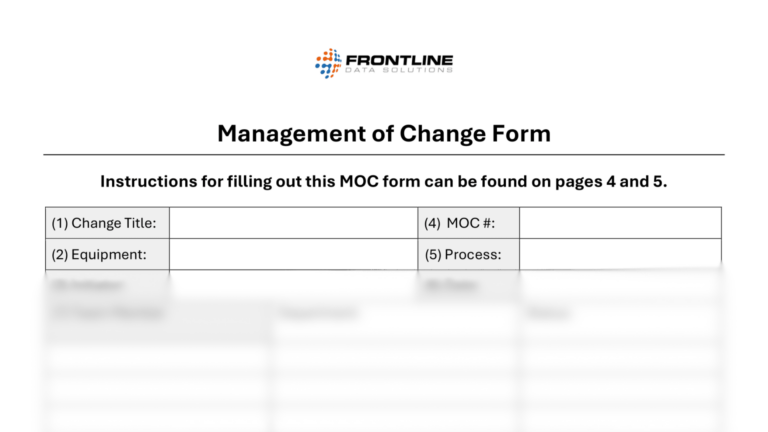
Free MOC Form
Download this free template to see the basics of what information to document.
Organizational Changes Don’t Get Attention
OSHA has clarified that MOC includes organizational changes as they relate to process safety. This includes changes in staffing, roles, responsibilities, and other organizational factors that can affect safety outcomes.
Examples include:
- Maintenance restructuring that changes who owns inspections or calibrations
- Contractor staffing that changes who performs safety-critical tasks
- Supervisor coverage that changes who can authorize work
- Turnover that affects institutional knowledge of abnormal operations
Overall, the hazard doesn’t care whether a role moved boxes on an org chart. If responsibility for a safeguard becomes unclear, the safeguard degrades. This can lead to costly near misses and safety incidents down the road.
Disconnected Pre-Startup Safety Review (PSSR)
Even when companies document management of change, they often fail in other areas:
- Startup occurs before action items close
- Field verification is incomplete
- Safeguard testing is assumed rather than verified
- Documentation is “to be updated later”
This is how you end up with a risky change that causes a shutdown, delay, or critical incident related to safety, brand perception, or operational efficiency.
Weak Action Tracking
If corrective actions and MOC tasks live in email threads, meeting notes, or spreadsheets, the system becomes dependent on individuals. Weak action tracking defers critical safeguards, stalls temporary changes, creates poor evidence trails, and causes recurring audit findings.
This means you pay twice: first for the inefficiency of your follow-up, then a second time through enforcement exposures or incidents.
Why Do Investigators Focus on MOC When Things Go Wrong?
When a major incident occurs, investigators and regulators don’t stop at what failed. They ask:
- Should the company have recognized the hazard created by this change?
- Were the safeguards still valid after the change?
- Did the right people have training?
- Was there documentation of the change?
- Who authorized the change and why?
If you can’t manage change, it’s hard to argue that you can manage process risk.
How MOC Compliance Gaps Turn into Real Costs
When it comes to management of change, here’s the pattern that shows up repeatedly.
First, operational pressure creates small, informal changes. This happens when a vendor part is unavailable, or a team rushes a process improvement so they can hit a KPI.
Then, someone bypasses or rushes the MOC process by doing a superficial hazard review, not completing documentation, failing to clearly define temporary change controls, etc.
Once this happens, the system involved in the change starts to drift out of alignment. For example, process safety information might not match what’s happening in the field or open action items start accumulating.
Lastly, the consequences of the MOC compliance gaps start to appear, often in expensive ways. This looks like an unplanned or prolonged downtime, a near miss or chemical release, a regulatory fine, or a serious incident.
This is why the cost of MOC failures goes beyond PSM compliance. When you don’t manage changes effectively (or at all), then your operation can suffer serious and costly setbacks.
What Does Strong MOC Looks Like in Real Operations?
More forms and checklists won’t make your MOC program stronger. All good MOC processes are standardized. A user-friendly process is the best way to increase MOC compliance across your sites and teams to close gaps and prevent costly mistakes.
Here are some ways to build a great MOC program:
- Create a clear definition of what requires formal MOC versus replacement in kind.
- Offer workers examples of MOC-covered changes, so they know when to submit a management of change request form.
- Match the MOC process to the risk level and scope of each change. That way, minor changes don’t overwhelm the system.
- Set specific due dates and owners for each follow-up task.
- Don’t allow the change startup to proceed until your team verifies completion of the PSSR and documents it.
- If documentation changes, give your team a refresher training course.
- Tightly link process safety information and procedures.
- Set a specific end date for temporary changes, so they expire.
- Require deliberate approvals for extensions to any temporary change due dates.
- Report temporary changes separate from the other operational changes your team is working on.
How Frontline MOC Software Reduces Risk and Cost
Most MOC compliance gaps happen because the process relies on emails, spreadsheets, Word and PDF forms, and individual conversations. That’s a system failure of communication and documentation. Frontline MOC software is a digital tool that closes gaps by:
- Standardizing the MOC process across sites and teams
- Creating a digital audit trail that demonstrates compliance to regulators
- Automating reminders and escalations for MOC action items, reviews, and approvals
- Configuring process steps depending on the risk level of the change
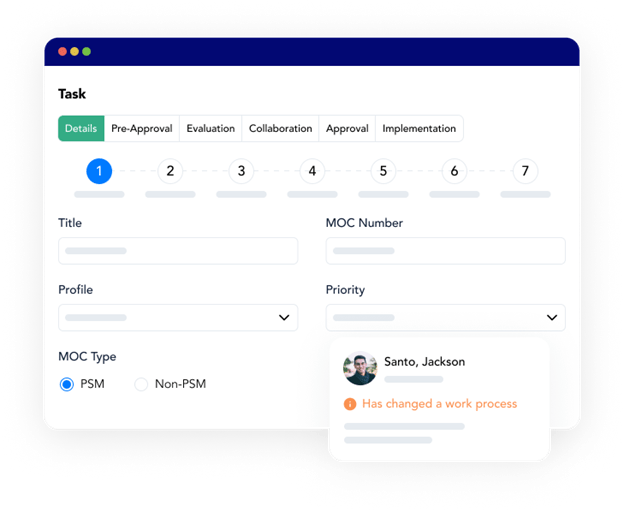
Our approach at Frontline Data Solutions aligns with this reality: configurable workflows, strong user adoption for frontline teams, and a unified EHS platform designed to simplify MOC especially where action tracking and change management break down.
MOC compliance gaps create costs across your company, from safety incidents to equipment failures. If you want an actionable takeaway, it’s this: you can’t eliminate change, but you can eliminate unmanaged change.
To get started with MOC process improvement, book a demo with our sales team and learn about the benefits of digital, standardized management of change.