

Written By:
Monica Kinsey
Monica is a former warehouse operations manager with 7 years of experience in process safety and workplace operations. She has a BS in Logistics, Materials, & Supply Chain Management.
Summary
Although management of change (MOC) is an OSHA compliance requirement, its real value is in operational performance and cost control. When teams handle changes inconsistently or informally, they experience delays, rework, downtime, and unnecessary administrative struggles. These issues compound over time, creating significant and often untracked costs across the operation.
The best MOC programs go beyond PSM and turn change management into a cost-reduction strategy. By standardizing workflows, clarifying responsibilities, and ensuring proper evaluation before implementation, MOC can help you execute changes faster and more effectively. Instead of reacting to problems after they occur, teams prevent them altogether.
This post covers how to reduce operational costs through the management of change process. With it, you can focus on standardization, execution discipline, and process efficiency. It also highlights how digital industrial solutions like Frontline MOC software enable companies to scale improvements, so teams spend less time on administrative work and more time driving meaningful operational improvements.
Key Takeaways
- Unmanaged change increases costs through downtime, rework, and inefficiency
- Standardizing MOC processes is the most effective way to reduce operational costs
- The biggest savings come from better execution, not additional documentation
- Administrative burden is a hidden but significant cost driver in many MOC programs
- MOC software enables faster, more consistent, and more scalable change management
How Does Unmanaged Change Increase Operational Costs?
Many teams underestimate how much unmanaged change impacts their bottom line. That’s because they’re only looking at the direct costs like buying or installing new equipment, hiring or downsizing, etc. They’re not factoring in the operational performance metrics that changes impact.
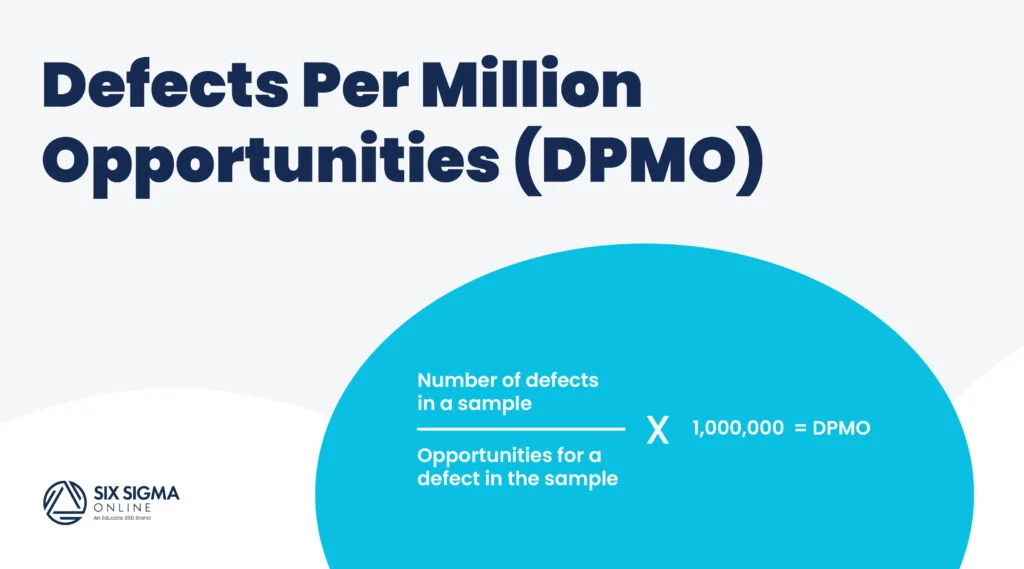
Take a product change for example. An unmanaged change to the production process can result in a quality issue that causes packaged goods to fail inspection. The defects per million opportunity (DPMO) metric increases. Along with it comes the labor cost of investigating the issue, rework to process all the rejected products, and the operational downtime that might happen if production lines stop or get backed up.
When change processes lack structure, teams often operate in a reactive mode. In practice, this looks like decisions that happen too quickly. Then, documentation eventually catches up but workers might rush or skip reviews entirely. This may seem efficient in the moment, but it creates downstream consequences that are far more expensive.
Common operational costs associated with poor MOC include:
- Delays caused by unclear approval processes or missing information
- Rework when changes fail or introduce new issues
- Time spent tracking down documentation, approvals, or historical decisions
- Equipment reliability problems due to poorly evaluated modifications
- Repeat incidents from a lack of visibility or follow-through
These issues are almost always the result of breakdowns within the MOC process. They rarely occur in isolation. A single poorly managed change can trigger multiple downstream problems, each requiring additional time, labor, and resources to resolve.
Over time, what begins as a small shortcut evolves into a pattern of reactive work, where teams spend more time fixing problems than preventing them.
Shifting from Reactive to Structured MOC
One reason teams might struggle with MOC is because they approach it in reactive mode. They make changes because there’s something wrong with the process, equipment, etc. Or sometimes changes only happen after there’s a major process safety incident.
Reactive MOC programs typically look like this:
- Informal initiation of changes
- Variations in approval processes across teams or sites
- Inconsistent or incomplete MOC documentation
- Manual corrective action tracking (or lack thereof)
For long-term success, you have to switch to a proactive state of mind. Change management should help you find risk and control it to reduce operational cost.
Structured MOC programs operate with discipline and consistency. This means that:
- Every change follows a defined process.
- There are clear roles and responsibilities.
- Documentation reflects the current state of operations.
- Teams track action items and complete them before startup.
Switching from a reactive to a proactive state eliminates variability, one of the key causes of operational inefficiency. Inefficient processes are wasteful, and they create a lot of cost that’s easy to overlook.
BOTTOM LINE: When teams know exactly how to manage a change, they move faster and make fewer mistakes.
Free MOC Compliance Guide to Help You Get Started
Download our MOC Compliance Guide, which breaks down OSHA’s management of change requirements in greater detail. This guide will help you understand what’s required to meet compliance and give you practical tips for improving your MOC program.
Aligning MOC with Operational Efficiency Goals
To get the greatest value from MOC, you need to treat it as part of operational efficiency, not as a separate OSHA compliance activity. When change management sits on the side of the operation, teams often view it as paperwork. When you build it into planning, execution, and continuous improvement, it becomes a practical tool for controlling cost and improving outcomes.
This alignment starts by connecting MOC to the goals your teams already care about:
- Less downtime
- Better reliability
- Simpler processes
- Audit readiness
- More accountability
When leaders position MOC in those terms, it becomes easier to earn adoption across operations, engineering, maintenance, and EHS.
For example, if a facility regularly launches improvement projects but struggles with delays during implementation, MOC can be the process that protects execution quality. Instead of slowing down improvement work, it helps projects move forward with better planning, clearer ownership, and fewer surprises. That framing makes the value visible in operational terms.
In practice, aligning MOC with efficiency means integrating it into maintenance planning, capital projects, procedure management, training, and action tracking. The more connected it is to real work, the more useful it becomes as a cost-reduction tool.
Why Does Standardizing MOC Reduce Operational Cost?
Standardization is the foundation of cost-efficient operations. Without it, every change is a unique event that requires teams to make decisions from scratch.
This variability usually causes delays, confusion, and missed steps.
Standardization creates consistency, removing unnecessary complexity. Instead of asking, “How should we handle this change?” teams follow a predefined path based on the type and risk level of the change they want to make.
Effective standardization includes:
- Clear definitions of what requires formal MOC
- Risk-based workflows that scale with the complexity of the change
- Defined MOC change request approval procedures
- Standard MOC documentation requirements
- Consistent timelines for reviews and implementation
If you can create this type of process, you can combat the decision fatigue your team’s probably facing each time they want to make a change. Plus, a standard process lowers the chances of people missing critical steps. Your teams will spend less time coordinating and more time executing. And that allows you to reduce operational costs through fewer labor hours and unexpected delays.
Where Does Your MOC Program Stand?
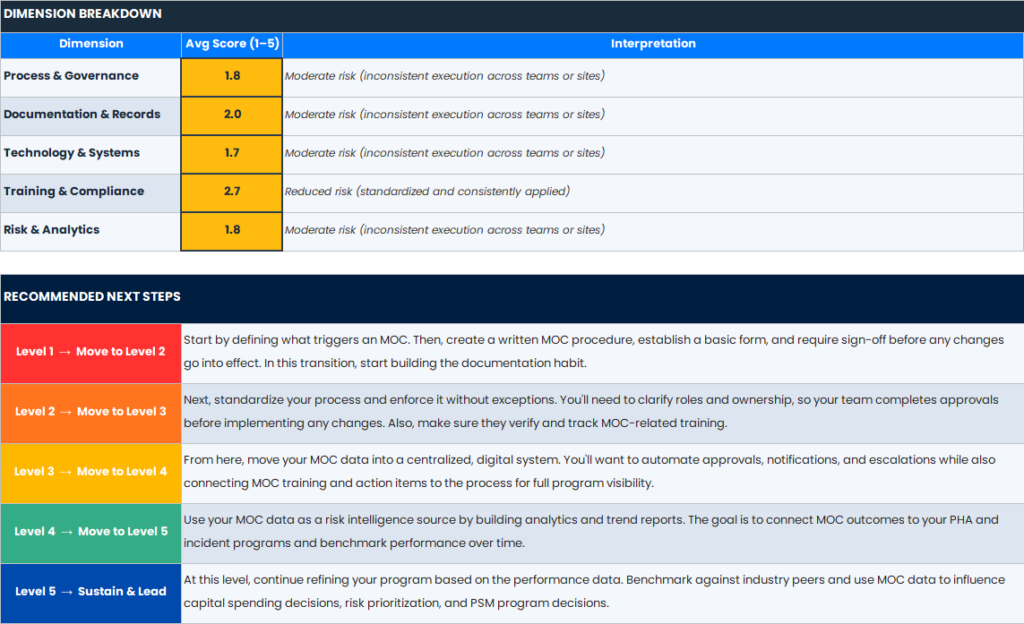
Our free MOC Program Maturity Assessment scores your program across five key dimensions, so you can see where you stand and get the next steps to move up.
Where Does MOC Deliver the Most Cost Savings?
What’s the average return on investment for management of change processes? It’s difficult to put a number on the average cost savings of an MOC program. That depends heavily on the company itself. For example, two manufacturers may have completely different hourly rates for frontline workers. One might have a higher throughput or a lower cost per unit. While these factors influence the specific ROI you could see from your MOC program, there are a few areas most likely to reduce operational costs.
Reducing Downtime During Changes
Unplanned downtime is one of the most expensive consequences of poorly managed change. When teams implement changes without proper validation, they increase the likelihood of:
- Startup failures
- Equipment malfunctions
- Process instability
- Emergency shutdowns
A strong MOC process reduces downtime by making teams:
- Technically evaluate changes before implementation
- Update procedures to reflect new conditions
- Verify readiness through structured pre-startup checks
- Monitor change post implementation for potential issues
This creates more confidence within the MOC process, minimizing disruptions to production.
Eliminating Rework and Duplicate Effort
Rework is a hidden cost that affects both productivity and morale. Oftentimes, it means that teams have to revisit incomplete hazard reviews due to issues with implementation. Other examples include changes that are partially implemented and then reversed or documentation that needs to be fixed.
Standardized MOC processes force alignment upfront. They make teams complete the necessary evaluations and approvals before implementation to avoid repeating work later. This not only reduces operational costs but also improves efficiency and consistency across the operation.
Reducing Administrative Burden
Administrative inefficiency is one of the most overlooked cost drivers in MOC programs.
In many companies, managing change involves sending email to request approvals or updating spreadsheets to track action items. Manual follow-up consumes valuable time, especially for skilled employees who could otherwise focus on higher-value work.
You can reduce these operational costs with MOC by:
- Centralizing all change-related information
- Automating task assignments and reminders
- Providing real-time visibility into process status
This way, you’ll spend less time managing workflows and more time improving operations.
Improving Equipment Reliability
Without MOC, changes often lead to equipment reliability issues. This typically happens when teams modify equipment or the processes and procedures that affect them without proper evaluation. Because of this, there might be increased maintenance requirements, unexpected failures, lower asset lifespan, and other related issues.
MOC processes help prevent these issues by requiring technical validation before implementation. That way, changes align with design specifications and operational requirements. The result is fewer operational disruptions and lower maintenance costs.
Preventing Repeat Issues
As a reminder, the goal is to get to a proactive state of change management. You don’t just want to manage change that’s happening right now. Instead, use your MOC process as a means of identifying risk and tackling areas where incidents happen repeatedly.
One of the benefits of a strong MOC program is improved knowledge retention via documentation. When your team properly documents and tracks changes, they create reliable historical data for you to analyze. You can use this data to target specific areas and prevent:
- Temporary fixes from becoming permanent without evaluation
- Known issues from resurfacing over time
- Teams from repeating past mistakes
This continuous improvement cycle reduces long-term costs and strengthens overall operational performance.

What Does a Cost-Efficient MOC Program Look Like?
Companies that reduce operational costs with management of change usually share several characteristics. Their MOC process is standardized, visible, and designed for execution. People understand when to use it, what is expected of them, and how to move changes through the workflow without unnecessary confusion.
A cost-efficient MOC program typically includes:
- Clear definitions for what requires formal review
- Risk-based workflows that match the complexity of the change
- Designated owners for each task
- Up-to-date documentation requirements
- Reliable action tracking
It also includes enough visibility for leadership to identify bottlenecks and measure performance over time.
In real operations, this may look like an MOC software system where each change request includes the technical basis for the change, the safety and operational impact, affected documents, required approvals, pending actions, and training requirements. That structure creates consistency without forcing every change through the exact same level of rigor.
What matters most is that the program helps your teams execute changes correctly the first time. When the process is clear and scalable, MOC stops feeling like an administrative burden and starts functioning like an operational control that saves time, reduces errors, and lowers cost.
How to Standardize MOC Without Slowing Down Operations
A common concern is that standardization will introduce delays. This can happen if processes are overly complex or poorly designed. However, high-performing companies. balance structure with flexibility.
They do it by:
- Matching MOC review requirements for each change based on its level of risk
- Having optional stages for low-risk changes so they can move faster
- Automating routine steps like action item assignment or approval reminders
- Creating a simple workflow for their team to follow
The goal isn’t to add more steps but to ensure that the right steps happen consistently. When done correctly, standardization speeds up operations by removing uncertainty and reducing rework.
Companies that successfully reduce operational costs with MOC have strong accountability at both ends of the process. From the moment someone submits a management of change request form, they know exactly who’s in charge of approving, reviewing, coordinating, and monitoring the change. These teams have detailed logs of all decisions related to their MOC, not just for PSM compliance, but for internal reviews. They no longer view MOC as a barrier. Instead, they see it as a tool that helps them execute changes more effectively.
MOC Cost Reduction Opportunities by Area
The table below shows where MOC most often affects cost, what the issue looks like in real operations, and how a stronger process helps your teams reduce waste.
|
Area of Impact |
Common Cost Issue |
How MOC Reduces Cost |
Operational Benefit |
|
Change Execution |
Delays and failed startups |
Structured reviews, approvals, and readiness checks |
Faster implementation |
|
Documentation |
Incomplete or outdated records |
Standardized updates to procedures and records |
Reduced rework |
|
Administrative Work |
Manual tracking and follow-up |
Automation and centralized visibility |
Time savings |
|
Equipment Reliability |
Poorly evaluated changes |
Technical validation before implementation |
Fewer failures |
|
Knowledge Management |
Lost or inconsistent information |
Complete audit trail and action tracking |
Fewer repeat issues |
How Frontline MOC Software Helps Reduce Costs
Even the best process design can break down when it relies on manual coordination. If your MOC workflow depends on spreadsheets, inboxes, disconnected documents, and individual memory, it becomes difficult to maintain consistency across teams and sites. That inconsistency creates cost through delays, missed steps, poor visibility, and unnecessary follow-up.
Frontline MOC software helps reduce those costs by turning your change process into a structured, digital workflow. Standardized process steps make expectations clear. Configurable routing allows you to scale the workflow based on the type or risk level of the change. Automated reminders and escalations help your teams keep work moving without constant manual intervention.
Its key capabilities include:
- Standardized workflows across sites and teams
- Delineation between PSM and non-PSM changes for compliance reporting
- Configurable processes based on change risk
- Automated reminders, approvals, and notifications
- Centralized documentation and audit trails
- Integrated action tracking for complete visibility
- Analytics dashboards for real-time status updates
These features eliminate many of the inefficiencies associated with manual MOC systems.
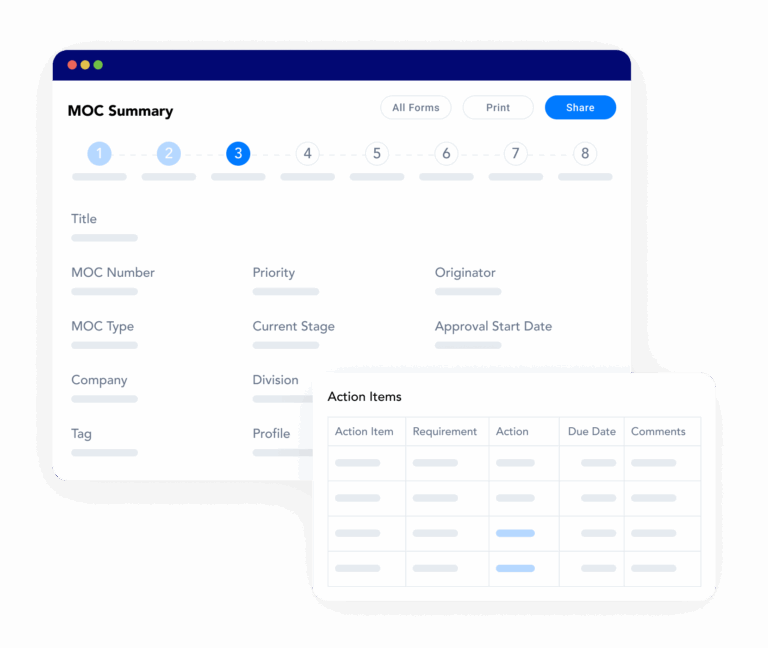
As a result, companies that use Frontline MOC have smaller administrative workloads, so they can focus more on continuous improvement.
The software also creates a centralized record for each change. That means your team can see what was requested, who reviewed it, which documents were affected, what actions remain open, and whether training or startup checks have been completed. Instead of searching across multiple tools, you work from a single source of truth.
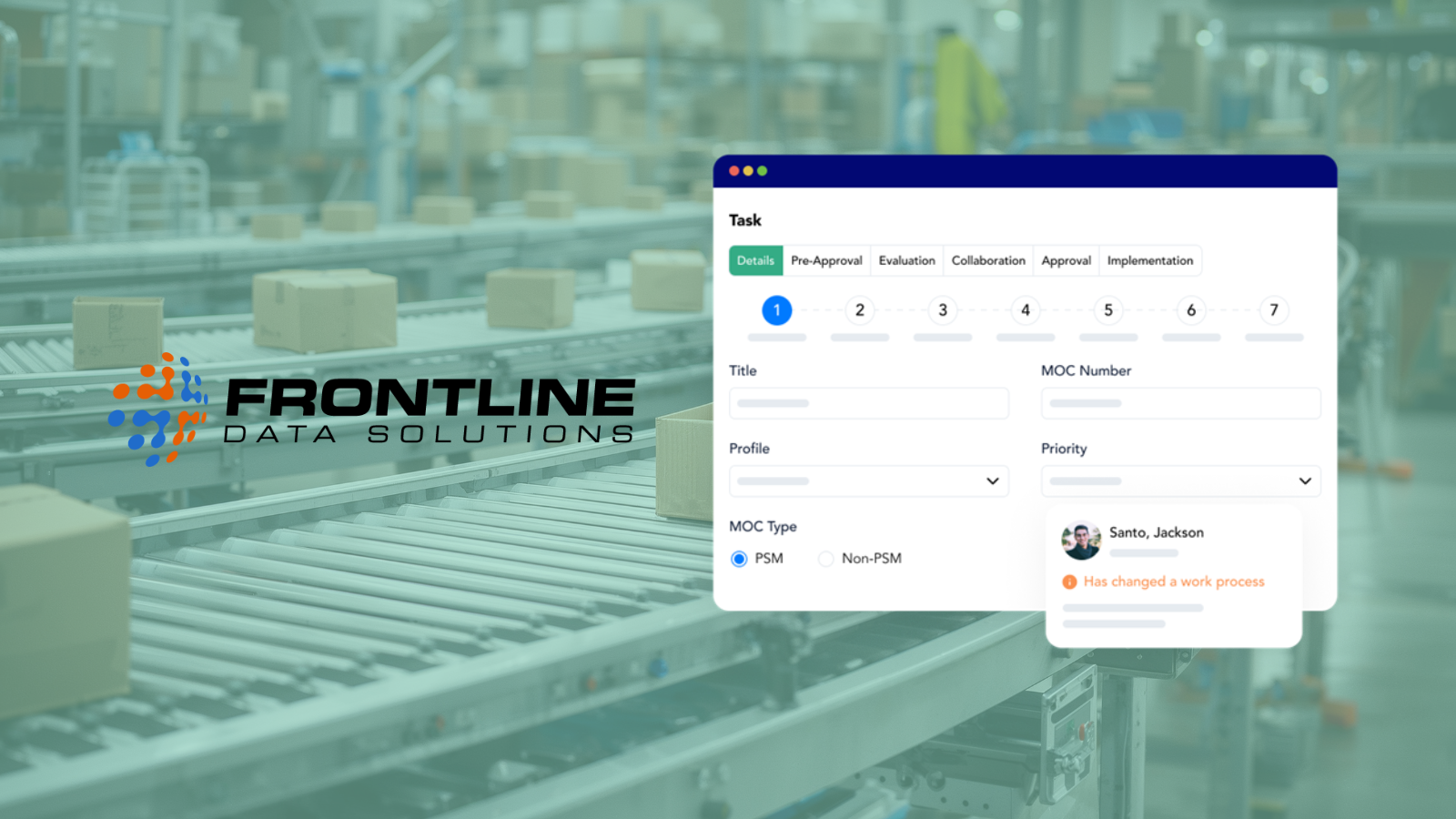
In practice, this helps your teams spend less time on administration and more time improving operations. It supports consistency across sites, reduces friction in reviews and approvals, and makes it easier to close MOC compliance gaps while improving execution.
That’s where Frontline becomes more than a documentation tool. It becomes a practical way to reduce operational costs with management of change.
How Do Teams Simplify with Frontline MOC?
One of New Zealand’s biggest energy producers, Todd Energy, uses Frontline MOC to manage hundreds of changes at once. As they started to grow, their team outgrew manual MOC processes. They switched to Frontline, so they could spend less time on administrative work and reinvest that time in continuous improvement.
With Frontline MOC, Todd Energy evaluates and completes changes more efficiently than their previous system. There are a couple of key reasons why:
- They can categorize MOCs by risk, working on the most important changes first.
- The MOC workflow automatically moves changes through the process, preventing employees from skipping steps and creating rework later.
- With the analytics dashboards, they can see the status of all their MOCs at once.
- Automatic task routing eliminates the need for running down approvals in person.
- Detailed MOC logs make them ready for compliance at a moment’s notice, so their audits go smoothly.
Todd Energy Scaled Its PSM Program with Frontline MOC
Todd Energy used Frontline MOC to overhaul their PSM compliance program, and now they’re able to management hundreds of changes at once.

With MOC software, teams gain the ability to focus on meaningful operational improvements instead of managing paperwork. If you want to reduce operational costs, then you have to standardize your processes so they’re more efficient.
Ready to reduce operational costs with Frontline MOC? Book a demo with our sales team to discuss how it can help your team simplify and save.