


Written By:
Tiffany Gurary
Tiffany is an EHS professional with 15 years of experience supporting chemical manufacturing, research and development, pilot operations, and multi-site industrial environments.
Summary
Management of change (MOC) procedures are meant to reduce risk and improve communication and documentation when companies make operational changes. It covers everything from chemical substitutions to personnel changes. Many teams, however, still bypass the MOC process entirely. Changes happen informally through conversations, maintenance shortcuts, or “temporary” fixes that never receive formal review or documentation. Over time, this creates blind spots that increase the risk of safety incidents, production downtime, environmental releases, compliance violations, and costly rework.
In most cases, people skip the MOC process because they believe it slows them down. Sometimes the process creates unnecessary work or doesn’t match the work that needs to get done. Companies sometimes focus more on the written MOC program than the practical application of it. This post explores the human factors behind poor MOC participation, including:
- Production pressure
- Lack of ownership
- Process complexity
- Weak communication
- Cultural issues
- Inadequate training
Key Takeaways
- Most employees skip the MOC process when they believe it’ll slow them down.
- Poor MOC participation often points to issues with culture problems, not employee negligence alone.
- Temporary changes, maintenance workarounds, and undocumented field modifications create some of the highest operational risks.
- Simplified workflows, stronger communication, and frontline involvement improve MOC process outcomes.
- Configurable software like Frontline MOC helps reduce delays, improve visibility, standardize approvals, and increase accountability.
Free MOC Compliance Guide to Help You Get Started
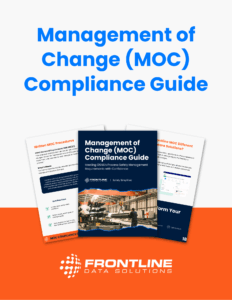
Download our MOC Compliance Guide, which breaks down OSHA’s management of change requirements in greater detail. This guide will help you understand what’s required to meet compliance and give you practical tips for improving your MOC program.
The Human Factor in Management of Change
Many companies tend to approach management of change purely from a compliance angle. They focus on things like forms, approvals, and documentation and assume that employees will follow the process once it’s in place. In reality, though, human decision-making on the spot is what ultimately determines the success of an MOC program.
Employees make dozens of fast decisions every day while balancing production schedules, maintenance demands, staffing shortages, shutdown timelines, contractor coordination, and unexpected operational problems. If the MOC process feels like it gets in the way of those responsibilities, workers start finding ways around it.
This becomes especially common when:
- Leadership focuses more on productivity than risk and compliance
- Teams believe small changes don’t require formal review
- Supervisors reward speed more than quality and/or consistency
- MOC process steps take too long to complete
- Employees don’t understand why the MOC process matters
- Departments follow MOC requirements differently
Most of the time, workers don’t intentionally violate procedures. It’s more common that they don’t think the operational risk of skipping MOC is big enough for it to be worth the hassle.
For example, a maintenance technician might temporarily bypass a valve interlock during troubleshooting to get the production line up and running faster. Another example is an operations supervisor who approves a small piping reroute verbally without initiating an MOC because the modification appears minor. Individually, these decisions create undocumented operational changes increasing the likelihood of incidents and audit findings.
The strongest MOC program make process steps user-friendly to increase participation. They also factor in leadership behavior and the overall culture to get workers engaged. In other words, they’re effective in real life and not just on paper.
The Most Common Reasons Employees Skip the MOC Process
In management of change programs, it’s important to be consistent with your expectations and clear in your instructions. The more wiggle room employees have to follow the process, the more likely they are to take shortcuts.
Some of the most common reasons employees skip MOC include:
- The process takes too long
- The approval process isn’t clear
- Employees don’t know what qualifies as a change
- Teams treat temporary changes as low-risk
- Production goals overrule compliance requirements
- Past MOCs create unnecessary delays
- Workers view MOC as paperwork instead of risk management
- Departments apply the process inconsistently
- Employees receive minimal MOC training
- Leadership bypasses the process themselves
Ambiguity is a big reason why so many teams struggle to manage changes (whether they do it for PSM compliance or not). One reason why is because they don’t have a clear definition of what requires a formal review. While workers might understand the importance of MOC for major equipment modifications, they might be uncertain about other, smaller changes.
When gray areas exist, workers tend to default toward operational convenience.
Another major issue involves approval delays. If workers believe the MOC process will stall maintenance work for several days, they may choose to skip it. Over time, teams start viewing the MOC process as an obstacle instead of a requirement.
This behavior becomes especially dangerous during shutdowns, turnarounds, and emergency maintenance situations where speed is the priority. Under pressure, employees often convince themselves that the change is temporary or low-risk enough to justify bypassing the process.
Free Download
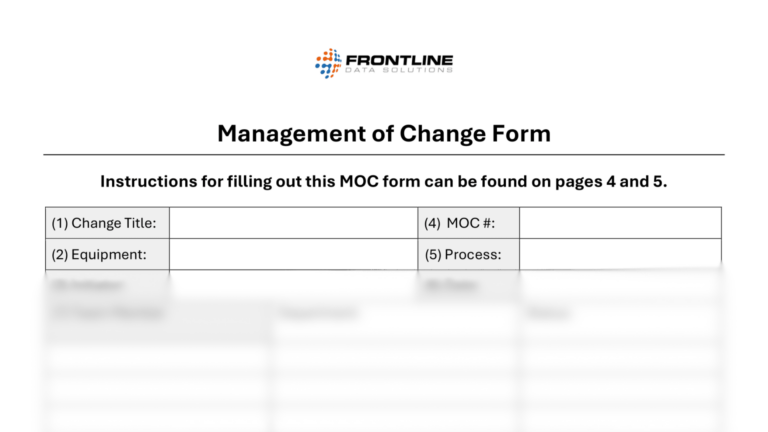
This management of change form walks you through the steps of reviewing changes for process safety compliance. It ensures no step is inadvertently missed during the process.
Production Pressure Drives MOC Noncompliance
Production goals influence almost every operational decision within industrial facilities. When leaders prioritize uptime, output, and schedule adherence over quality or safety, employees start making risk-based tradeoffs on their own.
This is one of the main reasons why MOC breakdowns occur.
Workers often experience competing expectations such as:
- Restore equipment quickly
- Avoid production downtime
- Keep projects on schedule
- Minimize operational disruptions
- Reduce maintenance delays
- Maintain compliance
- Complete documentation properly
When these priorities conflict, employees typically respond to whichever metric leadership reinforces most consistently.
For example, if supervisors praise rapid troubleshooting but rarely talk about MOC compliance, then workers focus on speed. Even teams with great written procedures can unintentionally create cultures where bypassing MOC becomes normal.
If managers approve undocumented operational changes verbally during emergencies, frontline workers view the process as optional under pressure.
Here are some of the expectations leaders should set for their MOC programs:
- Safety procedures are mandatory even during production challenges.
- Temporary changes still require review.
- Speed doesn’t override operational risk management.
- Supervisors are accountable for procedural compliance.
- Leadership follows the same MOC expectations as frontline workers.
Failing to reinforce these expectations creates recurring problems like:
|
Operational Pressure |
Resulting MOC Risk |
|
Aggressive production deadlines |
Informal process changes |
|
Emergency maintenance situations |
Temporary bypasses left undocumented |
|
Staffing shortages |
Reduced review quality |
|
Contractor schedule pressure |
Unapproved substitutions |
|
Turnaround compression |
Incomplete hazard reviews |
|
Equipment reliability problems |
Frequent undocumented workarounds |
Many catastrophic process safety incidents have happened because teams gradually normalized shortcuts over time.
Temporary Changes Create Long-Term Operational Risk
Temporary changes are among the most common concerns within MOC programs. Employees frequently view temporary changes as low-risk because they don’t expect them to last. In reality, these types of changes often remain in place far longer than intended.
Examples of temporary changes include:
- Bypassed alarms or interlocks
- Temporary piping reroutes
- Software overrides
- Manual operating procedures replacing automation
- Alternative chemicals or materials
- Portable equipment substitutions
- Temporary staffing changes
- Maintenance workarounds
- Modified operating limits
The problem is that teams frequently fail to track, review, communicate, or remove temporary changes properly. After all, it’s easier to identify permanent equipment modifications than temporary deviations happening daily across maintenance, production, engineering, and contractor activities.
Over time, workers may forget the original configuration or assume the temporary state is normal. On the compliance side of things, informal change management means documentation no longer matches actual operations,
This can lead to inconsistent maintenance procedures, unidentified hazards, or inaccurate operational assumptions.
One common example involves bypassed safety devices during troubleshooting. A bypass intended to remain active for only a few hours may stay in place for weeks if communication breaks down between shifts or departments.
Another example occurs during staffing changes. Facilities may temporarily assign inexperienced personnel to safety-critical tasks during labor shortages without fully evaluating competency gaps, training needs, or operational impacts.
Strong MOC programs treat temporary changes with the same seriousness as permanent modifications. They establish clear expiration dates, approval requirements, review checkpoints, and removal procedures.
Poor Training Creates Confusion
Employee training is one of the elements of MOC per the OSHA PSM standard. But training tends to fall through the cracks outside of the engineering or process safety teams. This means that large portions of the workforce might not fully understand:
- What qualifies as a change
- Why MOC matters operationally
- When to initiate the MOC process
- Who owns approvals
- What risks the process helps prevent
- How undocumented changes affect compliance and safety
This creates inconsistent decision-making across departments.
For example, maintenance personnel may receive different guidance than operations teams. And contractors rarely receive MOC information at all. Without standardized training, employees start following the management of change process when it suits them instead of when the change requires it.
Effective MOC training should include:
- Real operational examples
- Incident case studies
- Temporary change scenarios
- Human factor discussions
- Department-specific responsibilities
- Practical workflow demonstrations
- Examples of minor vs major changes
- Communication expectations
Training should also explain the business impacts of poor change management. This includes things like unplanned downtime, injuries and incidents, insurance or citation costs, and more. Long-term, employees are more likely to follow MOC processes when they understand the consequences of bypassing them.
Teams with stronger participation rates reinforce MOC training continuously instead of treating it as a one-time compliance event. They integrate change management discussions into their safety meetings, onboarding process, audit reviews, etc., to keep MOC front and center.
Complex Process Reduce User Adoption
If your MOC process is too complex, you’re at risk of having employees skips steps. This is even more so the case if the MOC steps are completely disconnected from the work process.
Management of change is complicated, so it’s not a surprise that lots of teams struggle to simplify it. But there are some common issues you can fix relatively quickly to make the process more user-friendly and increase adoption:
- Too many approval layers: Route approvals to a specific role within your team.
- Duplicate data entry: Do a weekly duplicates check to clean up your data.
- Unclear responsibilities: Write out the different roles within your MOC program.
- Slow notification processes: Use MOC software to create automatic notifications.
- Limited mobile accessibility: Get a mobile app for your team to log safety tasks.
- Inconsistent forms between sites: Create a standard template for all locations.
- Confusing terminology: Write procedures for an 8th grade reading level or below.
- Lack of visibility: Switch from email chains to spreadsheets or software for MOC.
Facilities with stronger MOC adoption usually focus heavily on simplifying execution without reducing risk controls. The goal is to remove unnecessary administrative tasks that discourage participation.
This is where configurable MOC software can significantly improve operational consistency. Instead of relying on spreadsheets, emails, paper forms, or disconnected approval processes, teams can standardize their MOC process and adapt it to what’s going on in the operation.
For example, configurable workflows can:
- Automatically notify reviewers
- Escalate overdue approvals
- Track temporary change expiration dates
- Store supporting documentation centrally
- Improve visibility into active changes
- Maintain audit trails automatically
- Standardize sign-off requirements
- Reduce delays caused by manual coordination
Simplifying the process improves the likelihood that employees will use it consistently.
Leadership Shapes MOC More Than Procedures
Don’t underestimate how strongly leadership behavior influences MOC participation.
Employees pay close attention to how supervisors and managers respond during operational pressure. If leaders bypass procedures, approve undocumented changes verbally, or discourage “slow” processes during production issues, employees quickly learn what behaviors matter.
Even well-written procedures become ineffective when leadership actions contradict them.
Weak cultures often have issues like:
- Informal verbal approvals
- Pressure to “just get it done”
- Blame-focused incident investigations
- Inconsistent enforcement
- Minimal visibility into open changes
- Limited communication between operations and safety teams
Strong MOC programs come when:
- Managers initiate MOCs consistently themselves
- Supervisors prioritize risk management even while under production pressure
- Leadership discusses operational risk openly
- Employees feel comfortable raising concerns
- Teams review change-related incidents transparently
- Accountability applies equally across departments
One major issue involves psychological safety. Employees are less likely to report undocumented changes or challenge unsafe decisions if they believe doing so could create conflict, delays, or negative attention.
Healthier operational cultures encourage employees to pause work and initiate formal review processes without fear of retaliation.
Leadership also plays a major role in defining expectations during emergencies. High-performing business prepare their teams in advance for how MOC applies during equipment failures, shutdowns, staffing shortages, etc. Without clear expectations, employees usually default toward speed.
Communication Breakdowns Cause Many MOC Failures
Management of change depends heavily on communication across departments. Even strong processes can fail when information doesn’t move effectively between operations, maintenance, engineering, contractors, and leadership.
Many changes affect multiple teams simultaneously, so if communication gaps exist, teams can experience situations where:
- Maintenance modifies equipment without operations awareness
- Contractors install unapproved components
- Shift teams receive inconsistent instructions
- Documentation updates never reach frontline personnel
- Training does not reflect current operating conditions
- Safety procedures reference outdated configurations
These situations are especially common in facilities managing multiple sites, rotating contractors, or complicated approval processes.
Here are some strategies that improve communication within MOC programs:
- Standardized change notifications
- Cross-functional review participation
- Shift turnover communication requirements
- Centralized documentation access
- Contractor communication procedures
- Real-time visibility into active changes
Teams also need to map out who should be informed during different types of changes. Below are some examples to consider:
|
Type of Change |
Teams That May Need Involvement |
|
Equipment modification |
Engineering, maintenance, operations, safety |
|
Procedure revision |
Operations, training, supervisors |
|
Software or automation changes |
Controls engineering, operators, maintenance |
|
Contractor scope changes |
Procurement, operations, safety |
|
Temporary bypasses |
Operations, maintenance, shift supervisors |
Overall, MOC is the most missed step in the process when communication responsibilities are vague.
How You Can Improve MOC Participation
Improving MOC participation requires more than stricter enforcement. The first step is to simplify the process and make it more user-friendly. Of course, you still have to meet compliance requirements, but a compliant process that no one follows will still lead to noncompliance.
Step one is to figure out where the process isn’t working. Are people skipping a specific step? For example, a lot of workers get impatient waiting for approvals, so if they take too long, MOCs either stall out or get pushed forward without enough review.
Once you know where the bottleneck is, you can decide how to fix it. If you’re losing track of your MOCs, this might mean implementing MOC software to simplify data management. On the other hand, if your employees keep bypassing the approval process, you might need to write a new policy that creates consequences for doing so.
Most of the time, workers skip the MOC step in the process because they just want to keep their projects moving forward. Facilities with stronger adoption address where employees experience the most frustration within the process and focus their efforts there.
Questions worth asking yourself include:
- Where do approvals get delayed?
- Which changes create the most confusion?
- What types of undocumented changes occur most frequently?
- Which departments bypass the process most often?
- Do employees understand what requires MOC?
- Are temporary changes being tracked effectively?
- Does leadership reinforce compliance consistently?
Involve frontline workers directly when improving your MOC process. Employees performing operational tasks daily often see problems leadership overlooks.
Successful improvement programs focus on balancing operational speed, usability, risk management, documentation quality, accountability, and communication. Rather than designing MOC entirely around compliance audits, design your systems around work that’s already happening in your operation.
How Frontline MOC Helps You Build Processes Workers Follow
An effective MOC process needs to have steps that fit work in the field. If employees see MOC as a burden, they’re more likely to skip it. When the process is easy to initiate, clear to follow, and visible to everyone involved, MOC becomes a normal part of managing operational risk.
Frontline MOC software provides a management of change process that workers are more likely to follow. It does this by replacing spreadsheets, email chains, paper forms, or verbal approvals with defined workflows, automatic notifications, and clear documentation requirements. This gives teams a structured process for submitting, reviewing, approving, and closing out changes. That way, responsibilities are clear across departments.
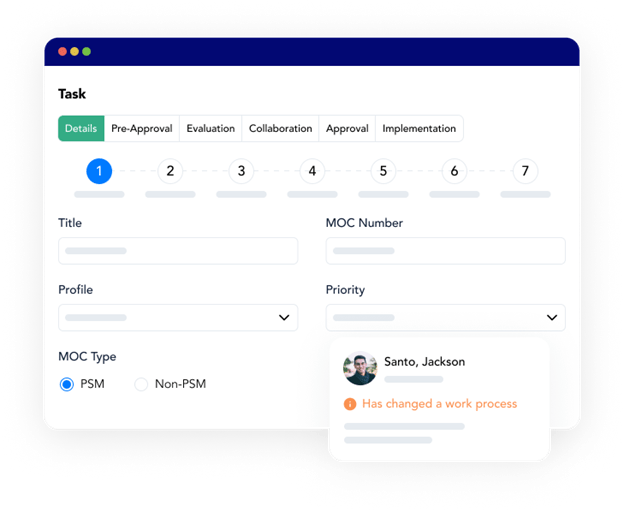
With Frontline MOC, you can:
- Configure optional workflow steps based on the severity of the change.
- Distinguish between PSM and non-PSM changes.
- Route approval steps automatically to individuals or roles.
- Send automatic notifications for review, approval, or implementation tasks.
- Track action items related to implementation.
- Store supporting documentation in one location.
- Maintain a clear audit trail of completed MOCs.
- Get real-time status updates for active, overdue, and completed changes.
- Standardize documentation across sites, departments, and teams.
Advantages of Frontline MOC
The biggest advantage is that Frontline MOC gives structure without forcing every you into a rigid process. You can build custom forms with the Smart Forms builder tool. That way, the forms your employees match in the system are the same ones they’ve been filling out by hand in the field. Plus, individual departments or sites can create custom forms if they have extra or different processes requiring unique forms.
With MOC software, you can improve communication across operations, maintenance, engineering, EHS, and leadership teams. When a change moves through a workflow, the right people can see what’s happening, what still needs review, and what actions remain open. This reduces the chance that a change gets approved verbally, implemented partially, or forgotten after a temporary fix.
The same applies to process updates, equipment replacements, chemical substitutions, personnel changes, control system modifications, and procedure revisions. Frontline MOC helps teams move these changes through a defined process while giving managers better visibility into risk, progress, and accountability.
Frontline MOC also supports leadership accountability. Managers can quickly see which MOCs are open, where approvals are stalled, and which action items are overdue. That visibility helps leaders reinforce the process without manually chasing updates across emails, spreadsheets, or meetings. It also makes it easier to identify recurring bottlenecks that might cause workers to skip the MOC process.
To improve participation, companies need a process that matches the reality of frontline work. Frontline MOC helps safety, operations, maintenance, and engineering teams standardize change management while reducing the workload causes people to skip the process. Book a demo to learn how Frontline MOC can help you build a management of change program that workers follow.