
Oil Spill Response Training Course
Oil spills can escalate into high-impact environmental and business crises within minutes. This training guide breaks down how they happen, how to respond effectively, and how to minimize risk through proven response strategies.
Who It’s For: Safety managers, supervisors, maintenance teams, and contractors
Time to Watch: 8–10 minutes
Summary
Oil spills are some of the most complex and high-risk environmental incidents that industrial companies can face. They occur across a wide range of operations, including transportation, refining, storage, and distribution. Whether caused by equipment failure, human error, natural disasters, or deliberate actions, spills can escalate quickly and create widespread environmental, operational, and reputational damage.
Effective oil spill response requires a coordinated, multi-layered approach that combines mechanical containment, chemical and biological treatment, and physical cleanup methods. Each method serves a specific purpose depending on environmental conditions, oil type, and response timing. Teams must understand these response strategies in depth and train workers to execute them efficiently under pressure.
At its core, oil spill response is about speed, coordination, and decision-making. The faster you contain and treat a spill, the more you can reduce environmental impact, regulatory exposure, and operational disruption.
Key Takeaways
- Oil spills can originate from equipment failure, human error, natural disasters, or intentional acts, making prevention and preparedness critical.
- Mechanical containment methods, such as booms and skimmers, serve as the primary line of defense in spill response.
- Chemical and biological treatments help break down oil and reduce long-term environmental impact when used appropriately.
- Environmental conditions like waves, currents, and temperature significantly influence the effectiveness of response methods.
- Rapid response and proper training directly impact the severity of environmental and operational consequences.
- Coordinated planning across teams, agencies, and contractors is essential for effective spill management.
FREE Safety Training Audit Template
Download our EHS Training Audit Template, which provides step-by-step guidance for auditing your training program. With it you, can find new opportunities to improve processes and achieve better training outcomes for compliance.

The Biggest Oil Spills of All Time and Their Impact
Aside from the environmental impact, oil spills are business events with long-lasting financial, operational, and regulatory consequences. Looking at some of the largest oil spills in history provides important context for why response training, planning, and execution matter so much.
Deepwater Horizon (2010)
The Deepwater Horizon spill in the Gulf of Mexico is one of the most well-known oil disasters in modern history. An offshore drilling rig explosion released millions of barrels of oil into the ocean over several months.
The business impact was massive:
- Tens of billions of dollars in cleanup costs, legal settlements, and fines
- Long-term damage to brand reputation and public trust
- Increased regulatory scrutiny across the entire oil and gas industry
- Operational shutdowns and delays across multiple offshore projects
This incident reshaped how companies approach offshore risk, emergency response, and compliance.
Exxon Valdez (1989)
The Exxon Valdez tanker ran aground in Alaska, spilling crude oil into a highly sensitive marine ecosystem. While smaller in scale than Deepwater Horizon, its environmental and reputational impact was profound.
Business consequences included:
- Billions in cleanup and legal costs
- Years of litigation and regulatory changes
- Significant damage to corporate reputation
- Increased requirements for tanker design and navigation safety
The spill led to major regulatory reforms, including stricter requirements for double-hull tankers and improved spill response planning.
Ixtoc I (1979)
The Ixtoc I blowout in the Bay of Campeche remains one of the largest accidental oil spills in history. It released oil for nearly a year before being contained.
It caused:
- Prolonged operational disruption due to uncontrolled release
- Extensive cleanup costs over a large geographic area
- Limited containment capabilities exposed gaps in response preparedness
- Increased focus on offshore drilling safety and well control
This incident highlighted the importance of having scalable oil spill response strategies for long-duration incidents.
Prestige Oil Spill (2002)
The sinking of the Prestige tanker off the coast of Spain caused widespread contamination across European coastlines.
Business and economic effects included:
- Severe disruption to fishing and tourism industries
- Large-scale government cleanup operations
- Legal disputes between governments, insurers, and operators
- Stricter maritime safety regulations across Europe
This spill demonstrated how oil incidents can ripple across entire regional economies, not just the responsible party.
Process Safety Improvement
Learn how NCTI uses Frontline MOC software to transform process safety.
What These Incidents Teach About Business Risk
Across all of these events, a consistent pattern emerges. The total cost of an oil spill extends far beyond immediate cleanup efforts. Organizations face layered consequences that can impact operations for years.
The most significant business risks include:
- Direct financial losses from cleanup, fines, and litigation
- Operational downtime and delayed production
- Increased insurance premiums and compliance costs
- Long-term reputational damage that affects future contracts and partnerships
- Regulatory changes that introduce new compliance requirements
In many cases, the indirect costs exceed the direct cleanup expenses. Lost business opportunities, reduced investor confidence, and ongoing legal exposure can continue long after the spill itself has been contained.
Why This Matters for Training and Preparedness
These incidents reinforce a critical point: response capability is not optional. Organizations that invest in training, planning, and coordinated response strategies are better positioned to:
- Contain spills faster and reduce environmental impact
- Minimize financial and operational losses
- Demonstrate compliance and avoid regulatory penalties
- Protect their workforce, assets, and reputation
Oil spill response training is ultimately about risk management. The ability to act quickly and effectively can mean the difference between a controlled incident and a multi-billion-dollar disaster.
Understanding How Oil Spills Occur and Spread
Once oil enters a water system, it behaves in predictable but dangerous ways. It typically floats and spreads outward, forming a thin layer across the surface. Over time, this layer becomes thinner, transitioning into a sheen that can cover vast areas.
This rapid spread creates immediate challenges for containment. The larger the spill, the more resources required to control it. At the same time, environmental exposure increases, especially for sensitive ecosystems and wildlife populations.
Oil spills rarely result from a single failure. Instead, they typically develop through a chain of events that may involve:
- Mechanical breakdowns
- Navigation errors
- Unexpected environmental conditions
For example, a tanker might lose propulsion and drift into hazardous waters, or a pipeline could rupture due to corrosion or pressure fluctuations.
External factors like hurricanes or acts of sabotage can also trigger large-scale spills. This makes it difficult to predict when and where incidents will occur, reinforcing the need for oil spill response programs.
What is the Environmental and Operational Impact of Oil Spills?
Oil spills have consequences that go far beyond the initial release. Environmental damage can persist for years, affecting ecosystems, biodiversity, and local economies.
A good example of this is the Deepwater Horizon spill in 2012. According to the National Wildlife Federation, this incident impacted at least 770 square miles around the wellhead. And moreover, “Scientists estimate the habitats on the bottom of the Gulf could take anywhere from multiple decades to hundreds of years to fully recover.”
Wildlife impacts are among the most visible and severe consequences of oil spills. Oil compromises the insulating properties of fur and feathers, leaving animals vulnerable to temperature extremes. Many species ingest oil while attempting to clean themselves, leading to poisoning and long-term health issues.
From an operational standpoint, spills can halt production, trigger regulatory investigations, and result in costly remediation efforts. Companies may face fines, legal action, and reputational damage that impact future opportunities.
Overall, oil spill response isn’t just an environmental issue. It’s a business continuity and risk management challenge that requires structured planning and execution.
Mechanical Containment is the First Line of Defense
Mechanical containment is the primary response strategy for oil spills in the United States. This involves physically controlling and recovering oil before it spreads further. Here are the main mechanical containment methods you should use to respond to spills.
Containment Booms
Booms are floating barriers designed to contain and direct oil on the water’s surface. They help concentrate oil into manageable areas, making recovery more efficient.
All booms share four key components:
- Freeboard to prevent oil from splashing over the top
- Flotation system to keep the boom afloat
- Skirt to prevent oil from escaping underneath
- Longitudinal support for structural stability
Different boom types serve different environments. For example, fence booms work best in calm water while curtain booms perform better in rough conditions. Another option, inflatable booms, offers flexibility but requires more maintenance.
Despite their popularity, booms have limitations. They become less effective in waves above one meter or currents exceeding one knot. This makes environmental conditions a critical factor in response planning.
Skimmers
Skimmers remove oil from the water surface and transfer it to storage for disposal or recycling. They’re most effective after booms contain oil.
There are three primary types of skimmers:
- Weir skimmers use barriers to collect oil at the surface
- Oleophilic skimmers attract oil using specialized materials
- Suction skimmers vacuum oil directly into storage systems
Each type offers advantages depending on oil thickness, debris presence, and water conditions. For example, suction skimmers perform well in calm water but require constant monitoring to prevent clogging.
Sorbents: Targeting Residual Oil
Sorbents play a critical role in removing remaining oil after primary containment efforts. These materials absorb or adsorb oil, allowing responders to clean up areas that mechanical equipment cannot reach.
To be effective, sorbents must be oleophilic (oil-attracting) and hydrophobic (water-repelling).
They fall into three main categories:
- Natural organic (e.g., straw, sawdust)
- Natural inorganic (e.g., clay, sand)
- Synthetic (e.g., polypropylene materials)
Synthetic sorbents often provide the highest absorption capacity, sometimes holding up to 70 times their weight in oil.
Despite their effectiveness, sorbents introduce disposal challenges. Contaminated materials must be handled according to regulatory requirements, adding complexity to response operations.
Watch the Oil Spill Response Training
What are the Chemical and Biological Response Methods?
While mechanical methods focus on containment and recovery, chemical and biological approaches aim to break down oil and reduce its environmental impact.
Dispersants
Dispersants break oil into smaller droplets that mix into the water column. This reduces surface slicks and minimizes shoreline contamination.
The process involves:
- Applying dispersants to the oil surface
- Breaking oil into microscopic droplets
- Allowing natural processes to degrade the oil
Dispersants are most effective when used quickly and under favorable environmental conditions. However, their use requires careful evaluation due to potential impacts on aquatic ecosystems.
Gelling Agents
Gelling agents transform liquid oil into a solid or semi-solid material that can be physically removed. While effective in certain scenarios, they require large quantities of material, limiting their practicality for large spills.
Biological Agents and Bioremediation
Biological methods accelerate natural degradation processes by introducing microorganisms or nutrients that break down oil.
Two primary approaches include:
- Fertilization to stimulate native microbial growth
- Seeding to introduce oil-degrading organisms
These methods are particularly useful in sensitive environments like wetlands and shorelines, where mechanical cleanup may cause additional damage.
Oil Spill Response Methods Comparison
Understanding when and how to use each oil spill response method is critical for making fast, effective decisions in the field. Each technique serves a specific purpose depending on environmental conditions, oil type, and response timing. The table below provides a practical comparison of the most commonly used methods.
|
Response Method |
Primary Purpose |
Best Use Case |
Key Advantages |
Limitations / Risks |
|
Mechanical Containment (Booms) |
Contain and control spread of oil |
Calm to moderate water conditions |
Immediate containment, prevents shoreline impact |
Less effective in high waves or strong currents |
|
Skimmers |
Recover oil from water surface |
When oil is concentrated within booms |
Removes oil for disposal or reuse |
Performance drops in rough water or debris-heavy areas |
|
Sorbents |
Absorb or adsorb residual oil |
Small spills or final cleanup stages |
Effective in hard-to-reach areas |
Disposal requirements and potential secondary contamination |
|
Dispersants |
Break oil into smaller droplets |
Offshore spills with minimal shoreline risk |
Reduces surface slick and wildlife exposure |
Environmental tradeoffs in water column |
|
Gelling Agents |
Solidify oil for easier removal |
Small to moderate spills in controlled areas |
Simplifies physical removal |
Requires large quantities; not scalable for large spills |
|
Biological Agents |
Accelerate natural biodegradation |
Sensitive environments like wetlands |
Enhances long-term environmental recovery |
Slower results; dependent on environmental conditions |
|
Physical Methods |
Remove oil from shorelines |
Coastal and land-based contamination |
Direct removal of contamination |
Labor-intensive and may disturb ecosystems |
Planning and Preparedness for Spill Response
Once oil reaches shorelines, responders shift to physical cleanup methods. These include:
- Pressure washing contaminated surfaces
- Using sorbents to remove oil residues
- Bulldozing or raking contaminated materials
Wildlife protection also becomes a priority. Techniques such as scare devices help keep animals away from contaminated areas, reducing exposure and mortality.
No response strategy can succeed without proper planning. You must develop spill response plans that account for:
- Equipment availability
- Environmental conditions
- Personnel training
- Communication protocols
Even with advanced technology, response effectiveness depends heavily on preparation. Equipment performance varies based on wind, waves, and currents, making real-world conditions unpredictable.
This reinforces the importance of training programs that simulate realistic scenarios and prepare teams to make quick, informed decisions.
Frequently Asked Questions About Oil Spill Response
Improving Training and Corrective Action with EHS Software
Oil spill response doesn’t just require technical knowledge. It also demands consistent training, clear accountability, and the ability to learn from every incident. Many companies struggle with fragmented systems, manual processes, and incomplete documentation, which create gaps in both preparedness and response.
A modern EHS software platform brings structure to these challenges by connecting training, incident management, and corrective action into a single system.
Strengthening Training With a Learning Management System
A learning management system like Frontline LMS ensures that all personnel receive consistent, role-specific training on oil spill response procedures. Instead of relying on manual tracking or one-time sessions, organizations can:
- Assign training based on job roles and responsibilities
- Deliver standardized content across multiple sites
- Track completion and certification status in real time
- Automate refresher training and compliance reminders
This creates a team that continuously prepares for real-world scenarios and ensures that training records are available for audits and regulatory inspections.
Closing the Loop With Corrective Action Tracking
Training alone doesn’t prevent incidents. You need to find the gaps in your safety program, respond to issues, and follow up on corrective actions.
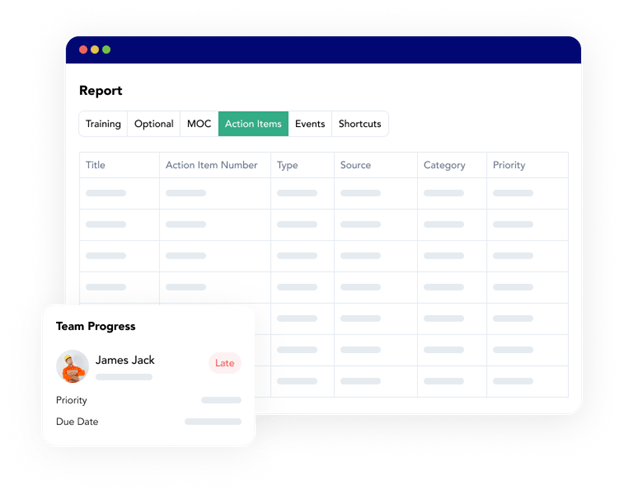
Frontline ACT action tracking software enables teams to:
- Capture incidents, near misses, and inspection findings
- Assign and monitor corrective actions in real time
- Identify recurring issues and risk patterns
- Ensure accountability across teams and locations
This transforms isolated incidents into actionable insights. Instead of reacting to problems after they occur, you can proactively address root causes and prevent repeat events.
Building a Proactive Safety Program
When training and corrective action systems work together, they create a continuous improvement loop. Employees receive better training, leaders manage incidents more effectively, and companies gain visibility into their overall safety performance.
This aligns directly with the needs of high-risk industries, where regulatory compliance, operational efficiency, and risk management must work together to protect both people and the environment.
If you’re an oil and gas company looking to strengthen your oil spill response program and improve overall EHS performance, the next step is to see how a unified platform can support your team. Learn more about how Frontline’s EHS software can help by booking a demo.