
Written By:
Tiffany Gurary
Tiffany is an EHS professional with 15 years of experience supporting chemical manufacturing, research and development, pilot operations, and multi-site industrial environments.
Summary
Operational changes can create safety gaps when teams make changes without fully reviewing, documenting, communicating, and following up on the risks involved. These changes aren’t always major projects or formal process updates. They’re often temporary workarounds, equipment adjustments, staffing changes, procedure edits, contractor-related changes, or informal decisions made to keep production moving.
This post explains why unmanaged change is so difficult to detect, how communication issues create operational risk, and why manual tracking methods often don’t provide enough visibility. It also outlines what a stronger change management process should include and how Frontline MOC software helps teams standardize approvals, assign follow-up tasks, document decisions, and prevent small operational changes from becoming larger safety, compliance, or production problems.
Key Takeaways
- Small changes can create hazards as much as big ones if teams don’t evaluate them properly.
- Informal changes often happen because workers and supervisors try to solve immediate problems, creating long-term gaps when there is no formal review process.
- Temporary changes need clear ownership, expiration dates, documentation, and closeout steps, so they don’t become permanent by default.
- Communication issues can cause different teams, shifts, or departments to work from outdated procedures, assumptions, or hazard controls.
- Manual tracking methods make it harder to standardize change management across sites and departments.
- A strong MOC process helps companies manage change safely by routing approvals, assigning action items, tracking completion, and creating a centralized record of each decision.
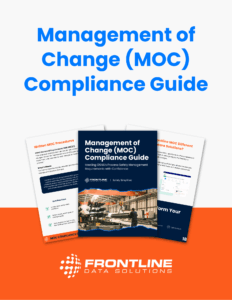
Free MOC Compliance Guide to Help You Get Started
Download our MOC Compliance Guide, which breaks down OSHA’s management of change requirements in greater detail. This guide will help you understand what’s required to meet compliance and give you practical tips for improving your MOC program.
Small Operational Changes Can Create Big Safety Risks
Operational changes rarely feel risky when they happen one at a time. For example, if a maintenance tech swaps a part with a slightly different specification, there’s not a lot of surface-level risk if the process isn’t affected. It doesn’t seem significant in the moment. However, most safety gaps start with exactly these kinds of changes.
The issue isn’t always the change itself. In many cases, the change is practical, necessary, and even beneficial. The real risk appears when teams don’t fully evaluate, communicate, document, and follow up on the change. When that happens, workers may operate with outdated assumptions or follow unsafe procedures. Plus, leaders might lose visibility over risks within the facility or process.
Unmanaged change is such a persistent safety challenge because it doesn’t always look like a major project or process change. Sometimes it’s a temporary workaround, quick equipment adjustment, or informal decision made during a busy shift. Over time, these small changes create gaps between how work is supposed to happen and how it actually happens in the field.
What Counts as an Operational Change?
An operational change is any change that affects how people, equipment, materials, procedures, or systems interact during work. Some changes are obvious, such as installing new equipment or modifying the production process. Others are easier to overlook because they feel routine or temporary.
Common examples include:
- Changing a production procedure
- Adjusting equipment settings
- Replacing parts, materials, or chemicals
- Modifying inspection, cleaning, or maintenance steps
- Changing staffing levels or roles
- Using a temporary workaround during production downtime
- Bringing in contractors for specialized work
- Updating software, controls, alarms, or monitoring systems
- Changing the physical layout of a work area
- Altering startup, shutdown, or emergency procedures
These changes can affect safety even when they don’t fall under a formal regulatory requirement. For example, a company might have a strong management of change (MOC) process for PSM-covered processes but still allow informal changes in non-PSM areas to move forward without the same level of review.
That creates a common blind spot because operational risk doesn’t only exist where a regulation explicitly requires documentation. It exists anywhere a change can affect worker safety, process stability, equipment reliability, product quality, environmental performance, or emergency response.
Why are Informal Changes So Easy to Miss?
Informal operational changes usually happen for understandable reasons. Teams want to solve problems quickly to avoid downtime, meet production goals, satisfy customer demand, or keep work moving when conditions change.
The problem is that speed can make a change feel less important than it really is.
When people bypass MOC, it’s usually because the process is unclear or difficult to follow. If the process is too complicated, workers try to find ways around it so they can keep up with productivity expectations. On the documentation side of things, manual systems make it hard for people to report or complete MOCs. Without accessible, up-to-date information, changes typically skip steps and leaders lose control over them. That’s how informal change becomes unmanaged over time.
Temporary Changes Deserve Formal Attention
Temporary changes are one of the most common sources of hidden safety gaps because they’re built around the assumption that they won’t last long.
It’s important to remember that temporary doesn’t necessarily mean low-risk.
Temporary procedures can expose workers to different hazards. A good example of this is material substitutions that affect chemical compatibility, labeling, PPE requirements, or emergency response procedures.
The risk increases when temporary changes don’t have clear expiration dates, review points, or ownership. Without those controls, temporary changes can slowly become permanent operating conditions without the documentation, training, or hazard review that a permanent change would normally require.
This creates several problems such as:
- Workers might not know whether the temporary condition is still active.
- Supervisors might not know who is responsible for restoring the original condition.
- EHS teams might not know whether procedures, training records, inspections, or permits need to be updated.
- Engineering or maintenance teams might not know whether the temporary fix introduced downstream effects.
A strong change management process should make temporary changes visible from start to finish. That includes documenting why the change is needed, what hazards it may introduce, who needs to approve it, how long it should remain in place, and what must happen before normal operations resume.
Free Download
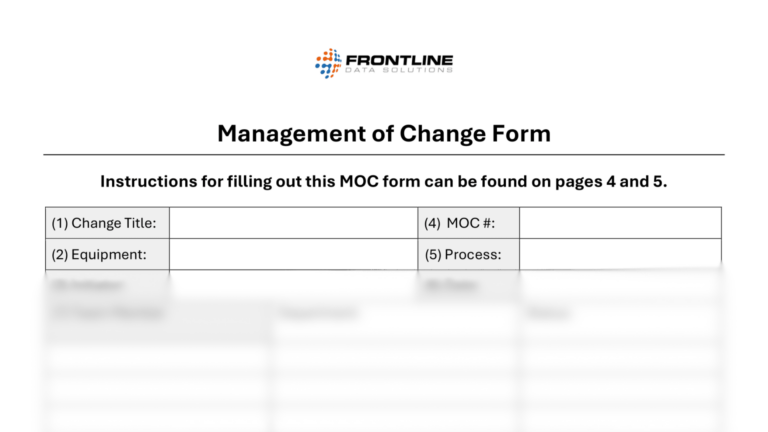
Download this template to see what documentation is required for the MOC element of OSHA’s PSM standard.
Communication Breakdowns Turn Change into Risk
Most safety gaps start with communication issues. The most common recurring problem is when someone makes a change and doesn’t share it with everyone else. This happens quite often within maintenance teams when someone alters or upgrades equipment without considering the impact it might have on frontline workers. And if workers don’t get an update, they might use the equipment incorrectly, increasing the risk of a safety incident or unexpected shutdown.
Breakdowns are more likely when communication depends on informal channels. Verbal handoffs, meeting notes, emails, and shared spreadsheets can all help teams coordinate, but they’re weak recording systems. They might decrease accountability by not reaching every affected person. Or they can be difficult to audit later.
For example, a single operational change may require several follow-up actions such as:
- Updating a written procedure
- Assigning refresher training
- Revising an inspection checklist
- Notifying contractors or temporary workers
- Updating equipment records
- Reviewing PPE requirements
- Changing a preventive maintenance task
- Capturing approval from safety, operations, engineering, or maintenance
- Verifying that the change worked as intended
If teams don’t assign, track, and complete these tasks, the company might believe a change is under control when only the initial decision was made. Just because someone approved a change doesn’t mean it will follow the MOC process from there on. Communication is key for making sure changes go through adequate reviews.
The Safety Impact of Unmanaged Change
Unmanaged change creates risk because it weakens the systems that workers rely on to make safe decisions. Some symptoms of change management issues include:
- Inaccurate or outdated work procedures
- Ineffective training programs
- Missed failure points during Inspections
- Contractors onsite without proper training
- Workers that don’t follow the same process
These effects can show up in several ways. First, unmanaged change can increase the likelihood of incidents and near misses. When workers don’t know that something has changed, they might use the wrong tool, follow the wrong step, wear the wrong PPE, or overlook hazards.
Second, unmanaged change can lead to equipment-related downtime. A small modification may affect reliability, maintenance frequency, operating limits, or alarm response. If you don’t review those effects in advance, you might discover them after a failure occurs.
Third, unmanaged change can create compliance and audit gaps. If you can’t show who reviewed a change, what risks you considered, what tasks you assigned, or when you completed follow-up actions, it’s much harder to prove that you have control over the process.
Fourth, unmanaged change can decrease accountability if teams don’t know who owns each step. This can look like delayed follow-up items, reminders that depend on manual effort, and leaders who lack a reliable view of what still needs attention.
Finally, unmanaged change can erode trust in the safety program. Workers notice when procedures don’t match the job. They notice when temporary fixes linger or when communication changes from shift to shift. Over time, this inconsistency can make formal safety processes feel disconnected from real work.
Why Manual Change Tracking Falls Short
Many companies start managing operational change with paper forms, spreadsheets, email approvals, and shared folders. This works when you’re only processing a few changes a year, but it gets much harder to manage the more changes you make. Also, if you add new sites, you have to manually organize MOC data, making the documentation process even harder.
Manual systems create several recurring problems, including:
- Documentation is incomplete because each person records information differently.
- Approvals stall because there’s no automatic reminder or escalation.
- Follow-up tasks fall through the cracks because workers track them outside the original change record.
- Reports take too long to compile because data is scattered across files and inboxes.
- Leaders can’t see overdue changes until they become urgent.
Manual tracking also makes it harder to standardize change management. One site may have a strong process for reviewing equipment changes, while another relies on informal approval. This inconsistency creates uneven risk across the company. It’s especially challenging for operations leaders who need to balance productivity with safety. They can’t afford a change process that slows everything down. On the other hand, they also can’t afford a process that allows critical risks to move forward unnoticed.
The goal is to make change visible, structured, and easier to complete correctly.
What Should Strong Operational Change Include?
An effective change management process gives teams a consistent way to evaluate and control risk without making the process so difficult that people avoid it.
At a minimum, MOC should define what types of changes require review. This should include things like:
- Formal process changes
- Equipment modifications
- Temporary workarounds
- Procedural updates
- Material substitutions
- Staffing changes
- Contractor-related changes
- Any adjustment that could affect safety or compliance
The process should also include a clear intake step. Workers and supervisors need an easy way to submit a management of change request and provide the right information up front. That may include the reason for the change, affected equipment or work areas, expected timeline, temporary or permanent status, potential hazards, and teams that need to review the request.
From there, the process should route the change to the right people. Depending on the change, this may include operations, EHS, maintenance, engineering, quality, training, procurement, or site leadership. The right reviewers should assess how the change affects safety, production, compliance, training, emergency response, and documentation.
A strong process should also assign and track follow-up actions. If a change requires a procedure update, training assignment, inspection revision, or contractor communication, those tasks should not be separate from the change record. They should be tied directly to the MOC so the team can see what must happen before implementation or closeout.
Finally, the process should create a reliable record. Leaders should be able to see what changed, why it changed, who approved it, what risks they reviewed, what actions they completed, and whether the change is temporary or closed out.
How to Prevent Safety Gaps from Operational Change
Preventing safety gaps starts with teaching your workers about MOC. Teams should know that change management applies to everyday operational decisions and not just the big changes that happen.
The next step is to simplify your MOC process, so it doesn’t feel like a major pain. A practical process should be easy to initiate, easy to route, and easy for frontline workers and supervisors to understand.
You should also build stronger connections between change management and other safety processes. An operational change may trigger new training requirements, corrective actions, inspection updates, or contractor communication. When these processes operate separately, your team can miss important handoffs.
Leadership visibility is also essential. Managers need a clear view of open changes, overdue approvals, incomplete action items, and temporary changes that are approaching their expiration dates. Without that visibility, the company depends too heavily on individuals remembering to follow up.
Most importantly, treat change management as an operational performance tool, not just a compliance requirement. A strong MOC program helps teams make changes faster and safer because it reduces confusion, rework, delays, and preventable disruptions.
How Frontline MOC Helps Teams Manage Operational Change
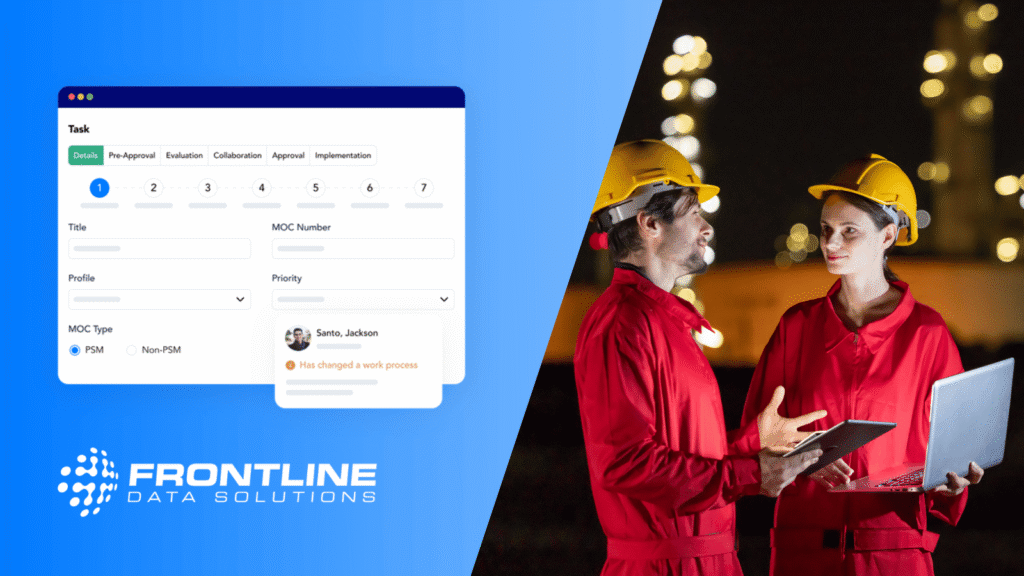
Frontline MOC software provides a structured, configurable way to manage operational change from request through closeout. Instead of relying on spreadsheets, email chains, or paper forms, teams can use a centralized software workflow to document changes, route approvals, assign follow-up tasks, and maintain a complete record of the process.
This is especially important for companies that want to manage more MOC beyond PSM-related changes. Frontline MOC provides the structure needed for formal change control, while giving teams the flexibility to configure forms and workflows around their actual operations. That means you can build processes for equipment changes, procedure updates, temporary changes, personnel changes, and other site-specific workflows without forcing every change through a rigid, one-size-fits-all process.
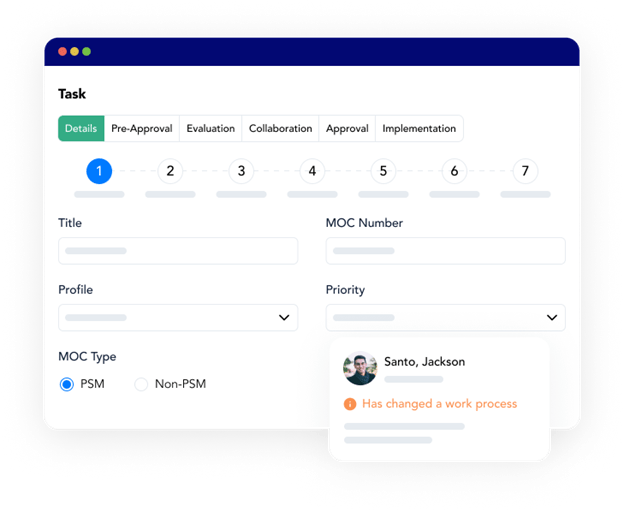
Frontline MOC also supports accountability. Teams can track the status of each change, who needs to take action, and which tasks are still open. Automated notifications and reminders help keep changes moving, while digital change logs make it easier to review completed MOCs, prepare for upcoming audits, and understand the decisions behind operational changes.
Frontline also supports a broader approach to risk management. The Frontline MOC tool can connect with action tracking, training, incident management, and other EHS processes so teams can manage the work that happens after a change is approved. That matters because many safety gaps appear during implementation, not during the initial review.
The result is a more reliable change management process that helps operations, EHS, engineering, maintenance, and frontline teams work from the same information. Changes become easier to evaluate, easier to communicate, and easier to close out properly.
Operational change will always be part of industrial work. The key is making sure those changes do not quietly create risks that teams only discover after an incident, audit finding, or production disruption.
Book a demo of Frontline MOC to explore ways to improve how your team identifies, reviews, communicates, and documents operational changes before they create safety gaps.