


Written By:
Tiffany Gurary
Tiffany is an EHS professional with 15 years of experience supporting chemical manufacturing, research and development, pilot operations, and multi-site industrial environments.
Summary
Building a culture of MOC compliance requires more than a well-written procedure or a software system. It depends on the commitment of leadership, clear accountability, practical training, and processes that make it easy for people to do the right thing. Companies that succeed at this treat MOC as a core operational discipline that protects workers, reduces risk, and supports continuous improvement.
The companies that do this best share common characteristics:
- They communicate the why behind MOC.
- They hold people accountable at every level.
- They design their processes for usability
- They use data to identify gaps before those gaps become incidents.
This post breaks down the specific practices and habits that separate high-performing MOC programs from those that exist only in binders.
Key Takeaways
- A culture of MOC compliance starts with leaders making it a priority and not just an administrative requirement.
- Clear accountability structures with defined roles and consistent enforcement are the backbone of effective MOC programs.
- Training needs to go beyond procedure review, so workers understand why MOC matters and what happens when they bypass it.
- If your MOC process is too difficult, people will go around it, so make your processes user-friendly for the best results.
- Data and tracking tools give you visibility into where your program is working and where it’s breaking down before a near miss or incident makes that visible for you.
Free MOC Compliance Guide to Help You Get Started
Download our MOC Compliance Guide, which breaks down OSHA’s management of change requirements in greater detail. This guide will help you understand what’s required to meet compliance and give you practical tips for improving your MOC program.
Why Most MOC Programs Struggle to Evolve
Process safety management regulations (including OSHA’s PSM standard under 29 CFR 1910.119) require covered facilities to implement MOC procedures for changes to process chemicals, technology, equipment, and facilities.
Many companies have documented MOC procedures (forms, workflows, records, etc.) that satisfy audits. But when you look at what’s actually going on in the operation, the story is different. For example, workers make changes before they fill out the MOC forms or they skip approval steps that might slow the project down.
This gap between process and practice is what typically causes incidents. The Texas City refinery explosion in 2005 and the Buncefield fire in the U.K. that same year both involved breakdowns in change management. More recent process safety events continue to reveal the same root cause: MOC processes that existed but workers didn’t always follow.
Compliance issues come from things like:
- Workers see MOC as a delay, not a safeguard.
- People don’t understand where the process boundary is, so they misjudge what qualifies as a change.
- Approval workflows are unclear or overly complicated, creating bottlenecks.
- Leaders don’t model the behavior they expect, and workers develop bad habits.
- There’s no visible consequence for bypassing the MOC process.
Building a real culture of MOC compliance means addressing each of these failure points systematically. It doesn’t happen overnight, but the companies that do it well all tend to follow a recognizable set of practices.
Leadership Sets the Tone and the Standard
Compliance culture starts at the top. That sounds like a cliché, but it’s operationally true. Workers pay close attention to what leaders do, not just what they say. If a plant manager routinely approves work that bypasses the MOC process because ‘we don’t have time right now,’ that sends a message that the process is optional under pressure. And in industrial environments, there’s always pressure.
Companies that build strong MOC cultures train and hold their leaders to the same standard as everyone else. Senior managers participate in MOC reviews. They ask for MOC status updates in operational meetings. They recognize and reward the engineer who flagged a potential change before initiating it rather than after. They don’t make exceptions for production urgency unless the MOC program itself has a defined temporary change provision that follows its own documented process.
Practically, this means building MOC into the operational cadence at the management level. Consider:
- Including open MOC counts and overdue approvals in weekly operations meetings
- Making MOC completion rates part of plant or department performance reviews
- Requiring senior sign-off on any change that affects a covered process or critical piece of equipment
- Having leaders conduct periodic MOC record reviews as a visible act of oversight, not just a delegated audit function
When people see that leadership takes MOC seriously enough to track it, discuss it, and intervene when it slips, the process gains credibility as something operationally important rather than administratively necessary.
Program Accountability That Actually Works
Accountability is one of the most overused and underimplemented words in safety management. In the context of MOC compliance, real accountability means people know exactly what they’re responsible for, they know the timeline, and there are clear consequences for not following through.
Define Roles Clearly
Every MOC should have a person responsible for initiating, advancing, and closing it out. In many facilities, this is the engineer or supervisor requesting the change. Supporting roles should be equally clear:
- Who reviews for safety implications?
- Who reviews for equipment or process impact?
- Who provides final approval?
- Who confirms that pre-startup safety review (PSSR) requirements have been met before the change goes live?
Ambiguity around ownership is a major reason MOCs stall. When multiple departments are involved and no single person has clear accountability for driving the process to completion, things fall through the cracks.
Build in Escalation, Not Just Reminders
Reminder notifications for overdue MOC tasks are useful, but they’re not sufficient on their own. Strong accountability escalates tasks to managers once they’re overdue. This creates visibility at the leadership level without requiring manual follow-up from whoever initiated the MOC.
Paper-based or spreadsheet-based systems can’t generate escalation alerts automatically. This is one area where MOC software tools make a measurable difference. With software, you can automatically notify people of deadlines to keep your changes on schedule.
Close the Loop on Every Change
One of the most common failures in MOC programs is approving and implementing changes without formally closing them out. Documentation requirements for completed changes, including updated P&IDs, revised operating procedures, completed PSSR, and employee training records, often get deferred and forgotten. During compliance audits, it’s not uncommon to find MOCs that someone opened and never closed or closed without complete documentation.
|
MOC Role |
Primary Responsibility |
|---|---|
|
Change Initiator |
Identifies the change, submits the MOC, provides technical details |
|
Process Safety Reviewer |
Evaluates hazards and risk implications of the proposed change |
|
MOC Approver |
Provides final sign-off before implementation |
|
PSSR Coordinator |
Verifies pre-startup safety review is complete before startup |
|
Training Coordinator |
Ensures affected workers have training on the change before it goes live |
Free Download
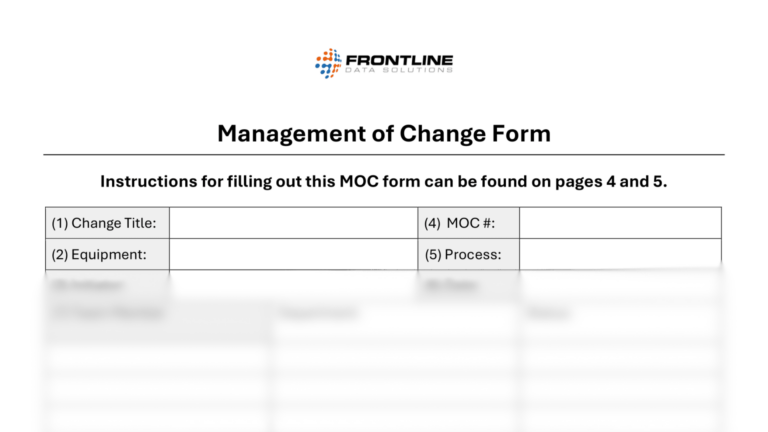
Download this free template and see what information you’ll need to collect for each MOC your team does.
Effective Training Before MOC Implementation
Most MOC training programs cover what an MOC is, what forms to use, and what the approval process looks like. But many fail to explain the why behind MOC, so workers don’t understand the importance of following the MOC process.
In general, people are more likely to follow a process they understand and believe in. When workers see MOC as a burden, than a legitimate safeguard, they’re much more likely to delay initiating one or justify why their particular change doesn’t really need one.
Use Real Incidents to Make It Tangible
One of the best ways to explain MOC is to talk about real process safety incidents. That way, you can tie your processes to the consequences of poorly managed changes. Use real examples from history, your own site, or peers in your industry. A great resource is the Chemical Safety Board website which has reports on process safety accidents.
When workers understand that a specific category of incident happened because someone made what seemed like a minor change without going through the process, the value of the MOC procedure becomes concrete.
Train Workers to Evaluate Situations
One of the most common MOC failures is the worker or supervisor who genuinely doesn’t recognize that a change requires an MOC. This is often a training gap. People need practice applying the definition of change to real-world scenarios.
Consider building case-based exercises into MOC training that ask workers to evaluate whether a proposed action, such as replacing a pump with a different model, using a slightly different chemical because the usual supplier is backordered, adjusting a set point outside its documented operating range, qualifies as a change. These exercises will help your team get better at evaluating situations and deciding whether they need to do an MOC.
Extend Training to Contractors
If an MOC impacts contractors, you need to provide them the same training you give your in-house employees. Contractors might not always understand MOC compliance requirements, so training them is key for avoiding violations. Make sure you onboard contractors with MOC process training, so there’s no knowledge gap across teams.
Designing Your MOC Process for the People Who Use It
If your MOC process is hard to follow, some people will go around it. This is more so a design problem than a motivation one. isn’t just a motivation problem. Facilities with the strongest cultures of MOC compliance tend to have processes that are rigorous enough to catch hazards but simple enough that people don’t actively avoid them.
Tiered MOC: Match Process Complexity to Change Risk
Not every change carries the same risk. Treating low-risk changes the same as high-risk ones creates unnecessary work. Many leading companies use a tiered MOC framework that matches the review and approval process to the risk level of the proposed change.
Here’s a simplified example to consider:
|
Tier |
Change Type |
|---|---|
|
Minor / Like-for-Like |
Replacement in kind with identical equipment, no process condition changes |
|
Moderate |
Equipment modifications, process condition changes within design limits |
|
Major |
Significant process modifications, design changes, new equipment additions |
This tiered approach gives you more flexibility for each change. If you have a small team or complex processes, a system like this will alleviate the workload while making sure everything gets the proper review and documentation.
Mobile Access and Field-Friendly Workflows
In many facilities, the people most likely to request a change are field operators, maintenance technicians, and frontline supervisors who aren’t always in front of a computer. If starting an MOC requires going to a shared computer in the control room to fill out a form, the likelihood of shortcuts increases.
Mobile access to MOC workflows removes one of the most common barriers to adoption. When a worker can open an MOC on a tablet or smartphone from the field, add photos and notes in real time, and route it for review immediately, the process becomes far more accessible.
Configurable Forms That Match Your Process
Generic MOC templates create compliance risk because they often don’t apply to the specific processes, equipment types, or regulatory requirements at a given facility. Forms that require irrelevant information or that don’t capture what actually matters for a particular change create confusion and promote shortcuts.
Leading companies configure their MOC forms to reflect their actual change categories, approval processes, and documentation requirements. A chemical company managing changes under PSM has different requirements than a food and beverage facility managing operational changes under its own internal program. The right tool lets you build the forms that fit your operation rather than forcing your operation to adapt to a generic template.
Using Data to Sustain and Strengthen MOC Compliance
A culture of MOC compliance requires ongoing visibility into how the program is actually performing. This means that the process is working the way it’s supposed to, not just that your records exist.
Companies that sustain strong MOC cultures use data proactively by tracking leading indicators and not just lagging ones. They don’t wait for an incident or audit finding to tell them something is wrong. Instead, they build dashboards and do frequent internal reviews to find gaps and fill them.
Here are some MOC metrics worth tracking:
- Total number of open MOCs by category, department, and age
- Average time from initiation to approval
- Total number of overdue action items
- Percentage of MOCs with complete documentation at closure
- MOC-related training completion rate
- Number of MOCs initiated versus changes identified in post-incident reviews
If your post-incident or near miss investigations regularly reveal that changes were made without MOC initiation, that last metric is a signal that your culture isn’t where it needs to be.
Regular Reviews That Go Beyond Audit Preparation
Many companies review their MOC records when an audit is coming. Companies with strong MOC cultures review them on a regular basis (quarterly at minimum, monthly for facilities with high change volumes or complex PSM-covered processes).
These reviews should ask operational questions like:
- Are there categories of changes with consistent delays to initiation?
- Are there specific departments or supervisors that regularly bypass MOCs?
- Are there approval steps that consistently create bottlenecks?
- Are training requirements met before changes go live?
Answering these questions proactively allows you to address systemic issues before they become audit findings or, worse, contributing factors in a process safety incident.
Making MOC Visible Across the Company
One of the more underappreciated drivers of MOC culture is visibility. When the status of active changes, including what’s in progress, pending approval, or overdue, is visible to the people responsible for them, accountability improves almost automatically. People are more likely to act when they can see that others can see the same information.
This applies at multiple levels. A plant manager reviewing a dashboard that shows 14 open MOCs with approvals overdue by more than 30 days is going to ask questions. Meanwhile, a worker who can see their open tasks in a mobile app is more likely to complete them on time.
Configurable dashboards are one of the most practical investments an MOC program can make. Real-time visibility into program status drives the accountability needed to keep compliance culture intact.
Building Continuous Improvement into Your MOC Program
A strong MOC culture treats the program as a living system that should improve over time based on experience, incident data, near misses, audit findings, and feedback from the people who use it.
Companies that do this well build explicit feedback loops into their MOC program. They review findings from process safety incidents and near misses for any MOC-related contributing factors. Audit observations, both internal and external, feed into a corrective action process. They also periodically ask workers and supervisors who use the MOC system what’s working and what’s not.
Continuous improvement helps with sustained engagement, so people are more willing to participate in a process they believe in. One way to build that belief is to demonstrate that their feedback leads to actual improvements. When a field operator raises that a particular MOC form is confusing and the form gets revised, that signals seriousness about making the system work for everyone.
Lastly, conducting MOC program review against regulatory requirements (OSHA PSM, EPA RMP, etc.) keeps the program on track and compliant.