

Written By:
Tiffany Gurary
Tiffany is an EHS professional with 15 years of experience supporting chemical manufacturing, research and development, pilot operations, and multi-site industrial environments.
(Editor’s note: This post was updated to include 2024 HazComm standards and more information about SDS management.)
Safety data sheets list out any requirements regarding the handling, transport, and storage of hazardous chemicals. To comply with safety data sheets requirements, these documents, previously known as material safety data sheets (MSDS), have to follow the standardized 16-section format set by OSHA’s Hazard Communication Standard and be kept where employees can reach them during every shift.. Safety data sheets should include information like the chemical manufacturer, distributor, or importer of the chemical.
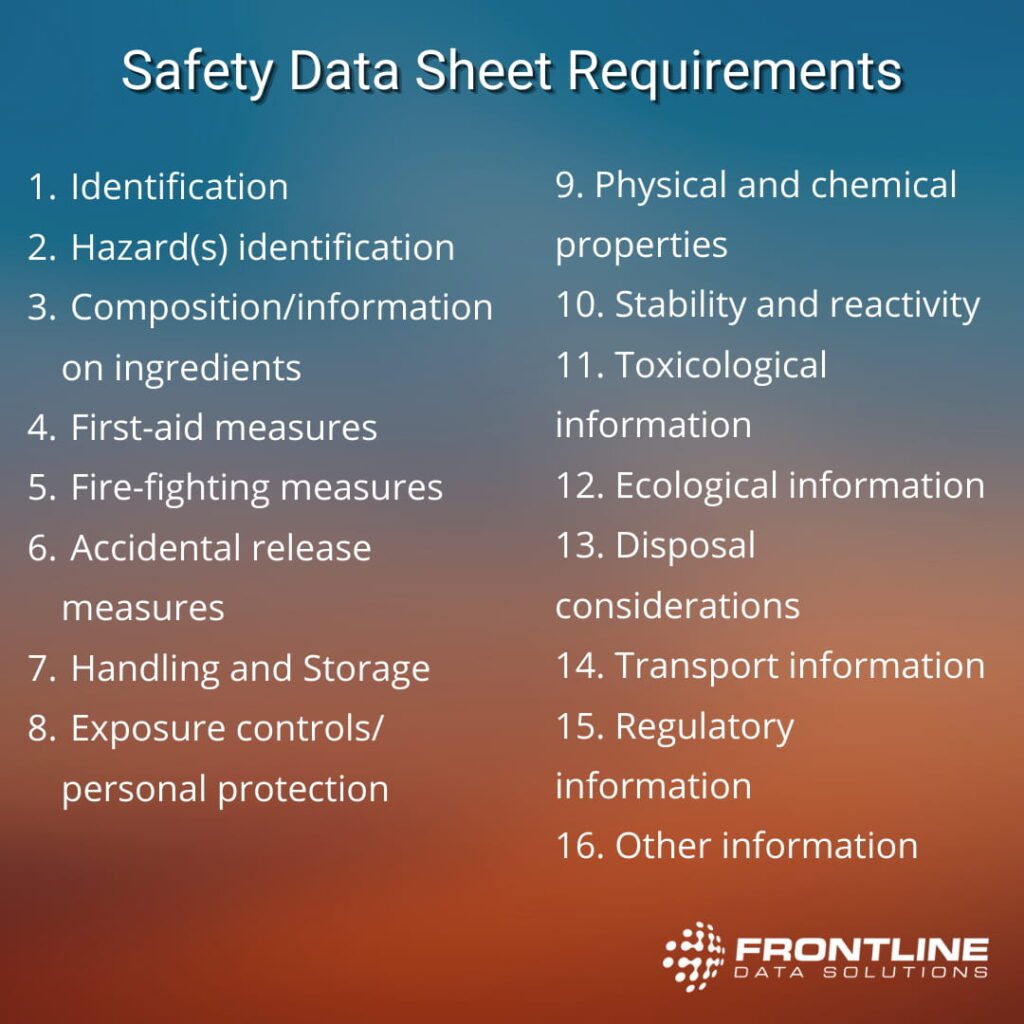
Ensuring employees are trained to read and understand safety data sheets can keep your workforce safe and avoid non-compliance. Employers are need to keep SDSs readily accessible in employee work areas during each shift. Of the 16 sections, sections 1 to 11 and 16 are mandatory. Sections 12 to 15 aren’t mandatory under OSHA. Here’s a wrap up of each SDS requirement under the Hazard Communication Standard.
If you don’t comply, OSHA penalties can be hefty.
Free template!
Use this comprehensive template to create safety data sheets for your own products and/or materials.
2024 HazComm Standard Updates
Regulations can change by the year. In May 2024, OSHA finalized its first major update to HazComm since 2012. Since these changes are phasing in through 2028, safety data sheets and labels you already have on file need to be revised.
These are the biggest changes
| Change | How to implement the change |
| Reclassified flammable gases, aerosols, and desensitized explosives | Update the SDSs and labels, and employees need training on the updates. |
| New labeling rules for very small and bulk containers | Label changes on some containers you receive. |
| Revised health hazard and precautionary statements | Newly revised SDSs and labels may word hazards differently from the versions you have now. |
| Employers must keep newly received SDSs and update any in-house (alternative) labels | Replace old SDSs as revisions arrive, and update your written program and training. |
The compliance dates moved in January 2026. OSHA moved every deadline forward by four months. Under the current schedule:
| Who | Substances | Mixtures |
| Manufacturers, importers, distributors (classify and update SDSs and labels) | May 19, 2026 | November 19, 2027 |
| Employers (update alternative labels, written program, training for new hazards) | November 20, 2026 | May 19, 2028 |
Mandatory safety data sheet requirements
The requirements for safety data sheets include quite a few mandatory sections. Below, I list each required section and what it entails.
Identification
The identification section contains all the basic information regarding the chemical. This includes the product identifier, contact information of the manufacturer, or importer, uses and recommendations when using the product and any restrictions there may be regarding the chemical.
Hazard identification
This section is different from identification because it focuses on the hazards involved when using or handling the product. The required information includes hazard classifications and statements, pictograms or signal words, a description of any hazards not classified, or mixtures that contain unknown toxicity.
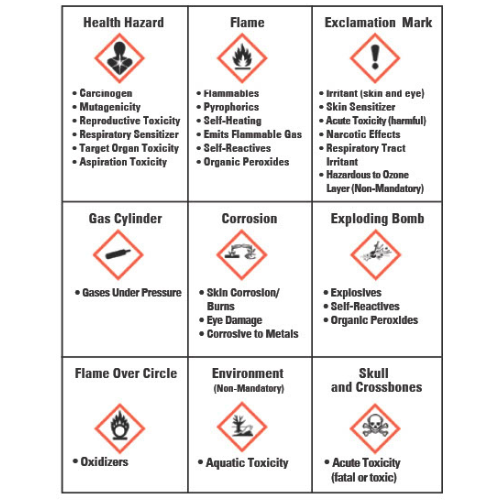
There are 9 different pictograms that could be used on safety data sheets. OSHA requires eight; the environment pictogram isn’t mandatory. Here’s a list of the different hazard symbols:
- Exploding bomb
- Corrosion
- Flame over circle
- Gas cylinder
- Environment
- Skull & Crossbones
- Exclamation
- Health Hazard
- Flame
Composition and information on ingredients on safety data sheets
The composition and the different ingredients used within the chemical are critical pieces of information for safely handling chemicals. This means the SDS should include the name of the chemicals or their synonyms, the CAS (Chemical Abstracts Service) number and identifiers, and finally the exact percentage, concentration, and cut-off of chemicals.
First-aid measures
Knowing the symptoms along with the necessary health measures that employees need to take in case of exposure to the chemicals can help save lives. That is why this section must include the potential symptoms or effects that people may experience when exposed. It should also contain first aid measures for different types of exposures.
Fire-fighting measures
For any potential fire hazards, employees must refer to the fire-fighting measures section of the SDS. This section will include recommendations on what to do during a fire like the required equipment and materials to properly extinguish the fire or protective equipment that must be used when handling the chemical.
Accidental release measures
Accidental release measures refer to the emergency actions in case of spills, releases, or leaks. It provides a list of emergency procedures needed to follow like evacuations, expert assistance or using the necessary protective clothing. This section also includes personal precautions that need to be taken along with cleanup and containment information to minimize the exposure of the chemical.
Handling and storage
Each chemical might have its own storage and handling requirements. Therefore, it’s critical to include this information within the SDS. Section 7 covers safe handling. It’s worth a read to learn the best hygiene practices and safe storage, including any incompatibilities.
Exposure controls/Personal protection
Exposure controls signify the limits of exposure and the personal protection that workers need to use when in contact with the chemical. There may be different exposure limits on the SDS such as OSHA’s Permissible Exposure Limit, the Threshold Limit Value (TLV) from ACGIH, or the recommended limits from the manufacturer, importer, or employer.
Physical and chemical properties
There are more than a dozen different features that go into the physical and chemical properties of the material. You must include all of these in the SDS. Some of these features are physical state, color, odor, boiling and freezing point, flammability, density, how it behaves when mixed with other chemicals and much more.
Stability and reactivity
The stability and reactivity section has 6 parts:
- reactivity
- chemical stability
- possibility of hazardous reactions
- conditions to avoid
- incompatible materials
- hazardous decomposition products
The types of information found under these sections will refer to the possibility of hazardous reactions, the conditions it can withstand, and any specific tests or observations that have been conducted. It’s important to remember that the more stable a chemical is, the less reactive it will be.
Toxicological information
Toxicological information will include information on the health effects of the chemical. From the routes of exposure and ATE (Acute Toxicity Estimate) to related symptoms and the lethal dose, this section provides the necessary values and data on what the health effects or the chemical could be.
Non-mandatory requirements for safety data sheets
The non-mandatory sections of SDS contain information about the environmental impact of the chemical, and how it should be disposed of and transported, along with other regulatory information. The ecological information section will talk about persistence and degradability, mobility in soil, and ecotoxicity. The disposal considerations of the chemical might include information on the handling and recyclability of the packaging of the material.
Although it isn’t mandatory, the UN number and the transport hazard class of the material can be found in the transport information section of the SDS. Section 15 (regulatory information) is also non-mandatory. Section 16 is required and you should show the date the SDS was prepared or last revised, and it may include other useful information.
To boil it down, requirements for safety data sheets are there to clearly describe the identification of the product, the hazards involved, the protection needed for safely handling the product and the response needed when dealing with exposures.
Employer responsibilities for SDSs
Who provides what
Chem manufacturers and importers write the SDS and send it with the first shipment and after any update, with the next shipment. Distributors pass it along. Companies need an SDS for every hazardous chemical they use. If a labeled hazardous chemical comes without one, you have to get it as soon as possible. You only write an SDS yourself if you make or import the chemical, which is where the free template above helps.
Keep SDSs in reach
During each shift, SDSs have to be readily accessible in work areas. You can opt for electronic access, but nothing can bar access like a login nobody remembers or a computer in a locked office. Employees who work at several locations can rely on SDSs kept at the primary facility if they can get info immediately in an emergency.
Keep a written HazComm program
Your written program describes how you meet the label, SDS, and training requirements. Include a list of hazardous chemicals (that you identify by product names that match the SDSs) and explain how the team can learn about hazards from non-routine tasks and from chemicals in unlabeled pipes.
Train employees
Employees need effective training on the hazardous chemicals in their work area when they are first assigned, and again whenever a new hazard is introduced. Training can cover hazard categories or specific chemicals, but chemical-specific details must always be available on labels and SDSs.