

Written By:
Tiffany Gurary
Tiffany is an EHS professional with 15 years of experience supporting chemical manufacturing, research and development, pilot operations, and multi-site industrial environments.
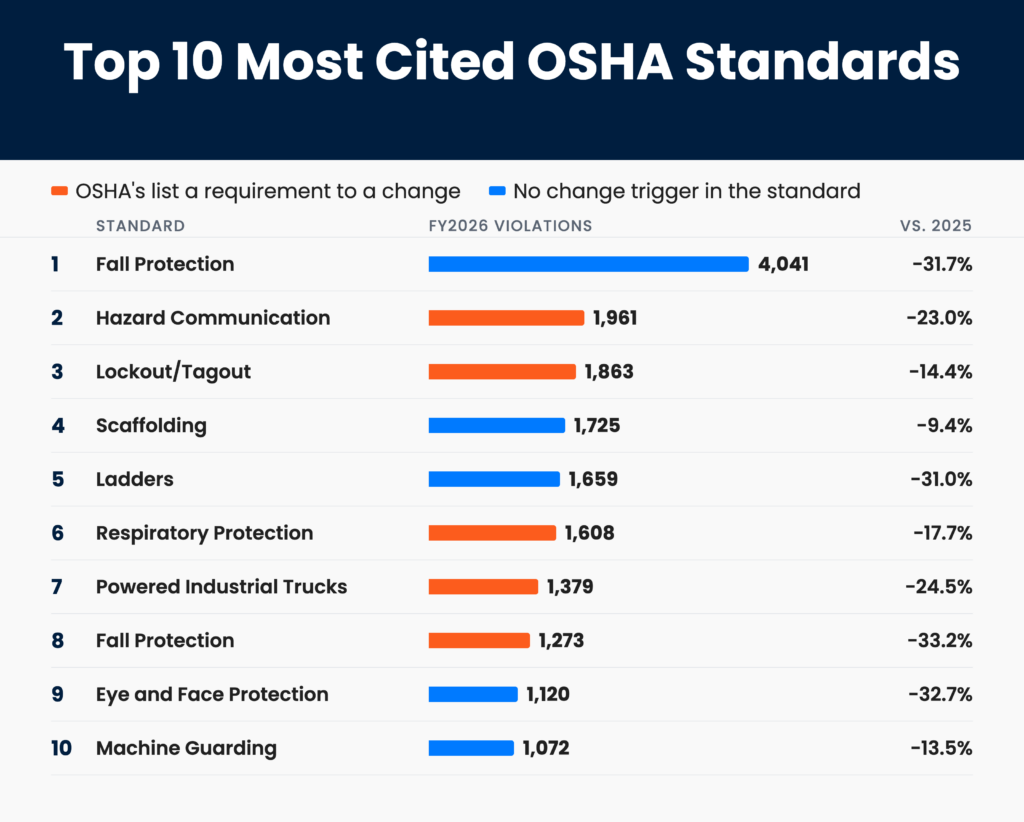
Each fall, OSHA unveils the list EHS teams plan their next year around. It lists the ten standards its inspectors cited most often. This year’s list covers October 1, 2025 through August 31, 2026 and was presented at the NSC Safety Congress in September (we were there!).
Our TL;DR: Fall Protection (29 CFR 1926.501) takes number one again with 4,041 violations. Hazard Communication (1,961) and Lockout/Tagout (1,863) follow in half the citations. The same ten standards appeared on last year’s list. Four of them (fall protection, scaffolding, ladders, and fall protection training) are about falls. Those four hold 8,698 of the 17,701 violations on the list (49%).
Keep reading to see the whole list, how each standard changed from 2025, and what each citation requires.
The FY2026 list at a glance
| # | Standard | CFR | FY2026 violations | FY2025 (prelim.) | Change | Rank vs. FY2025 |
| 1 | Fall Protection – General Requirements | 1926.501 | 4,041 | 5,914 | −31.7% | No change |
| 2 | Hazard Communication | 1910.1200 | 1,961 | 2,546 | −23.0% | No change |
| 3 | Lockout/Tagout (Control of Hazardous Energy) | 1910.147 | 1,863 | 2,177 | −14.4% | Up 1 |
| 4 | Scaffolding | 1926.451 | 1,725 | 1,905 | −9.4% | Up 3 |
| 5 | Ladders | 1926.1053 | 1,659 | 2,405 | −31.0% | Down 2 |
| 6 | Respiratory Protection | 1910.134 | 1,608 | 1,953 | −17.7% | Down 1 |
| 7 | Powered Industrial Trucks | 1910.178 | 1,379 | 1,826 | −24.5% | Up 1 |
| 8 | Fall Protection – Training Requirements | 1926.503 | 1,273 | 1,907 | −33.2% | Down 2 |
| 9 | Eye and Face Protection | 1926.102 | 1,120 | 1,665 | −32.7% | No change |
| 10 | Machine Guarding | 1910.212 | 1,072 | 1,239 | −13.5% | No change |
What’s different from 2025?
Each standard was cited less often than last year. The ten together total 17,701 violations, which is down 25% from 23,537 last year.
The rankings didn’t change much. Fall protection and Hazard Communication kept #1 and #2, and Eye and Face Protection and Machine Guarding kept #9 and #10. Scaffolding climbed a few spots, but not much changed significantly.
Lower count doesn’t mean safer worksites. The numbers show violations that inspectors cited, and that depends on how many inspections OSHA does. We know that OSHA inspections have been on a downward trend; they dropped 20% in 2025. They’re still a looming possibility, but local inspections are also a priority for safety teams in OSHA’s absence, too.
The timeframe is longer. The FY2026 window runs about three weeks longer than last year’s window, which understates the decline. Final counts usually run higher than preliminary ones, so this post compares preliminary to preliminary.
1. Fall Protection – General Requirements (1926.501): 4,041 violations
Fall protection has been the most cited OSHA standard for over a decade. Even though the count is down 32% from last year’s prelim total, it is still more than double the next standard on the list.
Most of the citations are from section 1926.501(b)(13): “Each employee engaged in residential construction activities 6 feet (1.8 m) or more above lower levels shall be protected by guardrail systems, safety net system, or personal fall arrest system unless another provision in paragraph (b) of this section provides for an alternative fall protection measure.”
The standard requires protection for construction workers who are at an unprotected side or edge 6 feet or more above a lower level (1926.501(b)(1)). Employers find the system for each task (guardrails, safety nets, or personal fall arrest) and need to make sure teams actually use the system.
What to check this month:
- List every task at 6 feet or more on your sites and record the fall protection method assigned to each one.
- Re-run the assessment when the job, roof, or equipment changes.
2. Hazard Communication (1910.1200): 1,961 violations
HazCom held #2. . Employers have to keep a written hazard communication program at each workplace (1910.1200(e)(1)) and keep an SDS for each hazardous chemical readily accessible during each shift ((g)(8)).
Training is where change shows up. Employees must be trained when they are first assigned and again “whenever a new chemical hazard the employees have not previously been trained about is introduced into their work area” ((h)(1)).
One of the most cited sections of the standard is (1910.1200)(e)(1): “Employers shall develop, implement, and maintain at each workplace, a written hazard communication program which at least describes how the criteria specified in paragraphs (f), (g), and (h) of this section for labels and other forms of warning, safety data sheets, and employee information and training will be met.”
What to check:
- Make each new chemical purchase trigger an SDS and training review.
- Reconcile your chemical inventory against your SDS library, including products brought by contractors.
3. Lockout/Tagout – Control of Hazardous Energy (1910.147): 1,863 violations
Lockout/tagout moved up one place to number three. Its standard calls for documented energy control procedures and inspection of those procedures annually (1910.147(c)(6)(i)).
It also covers retraining. Teams have to be retrained whenever there is “a change in machines, equipment or processes that present a new hazard” or change in energy control procedures ((c)(7)(iii)).
What to check:
- Trigger a procedure review and retraining whenever equipment is modified.
- Verify each machine has written procedure and someone owns the annual inspection date.
4. Scaffolding (1926.451): 1,725 violations
Scaffolding climbed three places, from seventh to fourth. Its count fell about 9%, so that’s the smallest fall on the list.
Team members on a scaffold more than 10 feet above a lower level need to be protected from falling (1926.451(g)(1)), and scaffolds must be inspected for visible defects by someone before each work shift ((f)(3)).
What to check:
- Verify fall protection for every worker above the 10-foot trigger.
- Name the person for every scaffold and keep the inspection record where crew can see it.
5. Ladders (1926.1053): 1,659 violations
Ladders fell to #5, with its count down 31%. The rules that got most teams? Portable ladder side rails must extend at least 3 feet above the upper landing surface (1926.1053(b)(1)). Ladders must be inspected by a competent person for visible defects on a periodic basis ((b)(15)), and ladders with structural defects must be tagged and withdrawn from service until repaired ((b)(16)).
What to check:
- Take ladder inventory and verify each one has documented inspection frequency.
- Tag and remove damaged ladders and record who did it.
6. Respiratory Protection (1910.134): 1,608 violations
Respiratory Protection dropped from fifth to #6. Employers need a written protection program with worksite-specific procedures (1910.134(c)(1)) and a medical eval to verify an employee’s ability to use a respirator ((e)(1)). Fit testing is required before first use and annually after that ((f)(2)).
Retraining is required when “changes in the workplace or the type of respirator render previous training obsolete” ((k)(5)(i)).
What to check:
- Keep medical evals and annual fit tests on a schedule with reminders.
- Match your written program to the respirators currently in use.
7. Powered Industrial Trucks (1910.178): 1,379 violations
Powered industrial trucks moved up just one place. Every operator must be competent to operate the truck (1910.178(l)(1)(i)), and safety teams have to perform an evaluation of each operator’s performance once every three years ((l)(4)(iii)). Refresher training is required when “a condition in the workplace changes in a manner that could affect safe operation of the truck” ((l)(4)(ii)(E)).
What to check:
- Trigger refresher training when you change aisles, racking, traffic patterns, or truck types.
- Track each operator’s evaluation date so no one passes the three-year mark unnoticed.
8. Fall Protection – Training Requirements (1926.503): 1,273 violations
Fall Protection fell to eighth and had the largest percentage decline on the list (−33.2%). Employers must provide a training program for each employee who might be exposed to fall hazards (1926.503(a)(1)), verify it with written record ((b)(1)), and retrain employees when changes in the workplace or in the types of fall protection systems or equipment render previous training obsolete ((c)(1) and (c)(2)).
What to check:
- Every employee exposed to fall hazards has a certification record.
- Retrain when the workplace changes or you switch to a different fall protection system.
9. Eye and Face Protection (1926.102): 1,120 violations
Eye and Face Protection held #9. Employers must make sure each affected employee uses appropriate eye or face protection when exposed to hazards from flying particles, molten metal, liquid chemicals, caustic liquids, chemical gases or vapors, or injurious light radiation (1926.102(a)(1)). Where there is a hazard from flying objects, the eye protection must provide side protection ((a)(2)).
What to check:
- Check that the safety glasses your team uses around flying objects have side protection.
- Tie PPE choices to a documented hazard assessment for each task.
10. Machine Guarding (1910.212): 1,072 violations
Last but not least of OSHA’s top 10 violations, machine guarding closed it out. Workplaces do not have effective machine-guarding programs to keep their employees safe.
The standard requires “one or more methods of machine guarding” to protect operators and employees from hazards: those created by the point of operation, ingoing nip points, rotating parts, flying chips, and sparks (1910.212(a)(1)).
1910.212 doesn’t define a change trigger, but modifications, retrofits, and maintenance are when guards usually go missing.
What to check:
- Walk your machines after every maintenance event and confirm guards are back in place and not bypassed.
- Check guarding whenever a machine is modified or relocated.
“Change” is the theme of the 2026 list
Five of the ten standards on this year’s list tie a requirement to a change: a new chemical, a modified machine, a different fall protection system, a shift in workplace conditions, and so on. Together those five account for 8,084 of the 17,701 violations on the list (46%!).
| Standard | Where OSHA ties the requirement to change | FY2026 violations |
| Hazard Communication (1910.1200) | (h)(1): training whenever a new chemical hazard employees haven’t been trained about is introduced into their work area | 1,961 |
| Lockout/Tagout (1910.147) | (c)(7)(iii): retraining when there is a change in machines, equipment or processes that present a new hazard, or a change in the energy control procedures | 1,863 |
| Respiratory Protection (1910.134) | (k)(5)(i): retraining when changes in the workplace or the type of respirator render previous training obsolete | 1,608 |
| Powered Industrial Trucks (1910.178) | (l)(4)(ii)(E): refresher training when a workplace condition changes in a way that could affect safe operation | 1,379 |
| Fall Protection – Training (1926.503) | (c)(1) and (c)(2): retraining when changes in the workplace or in the fall protection systems or equipment render previous training obsolete | 1,273 |
The rules expect you to have a process for change.
Change is easy to miss because it rarely looks like an event. As OSHA’s Prent Cline put it when the list was announced, fall protection violations “are often a failure to manage the job.”
Avoiding citations with MOC and ACT
Two habits prevent 46% of OSHA citations. The first is to review before you change.
An MOC process asks for a written request, a risk review, the needed approvals, and a list of everything affected by change (procedures, SDS, training, and guarding). For facilities covered by OSHA’s Process Safety Management standard, that’s a requirement under 29 CFR 1910.119(l).
The second is follow through after a change. Each ripple effect a change creates should be an action with an owner and due date.
May we humbly suggest Frontline?
Our MOC module routes change requests through configurable approvals, builds risk assessment into the process before sign-off, and keeps a full audit trail of every change. Then, our ACT module assigns and tracks corrective actions to completion so followup work feels effortless.
Safety Software pricing
Pricing Simplified.
Visit our pricing page to get a fast quote before you talk to sales.
Frequently asked questions
What is OSHA’s most cited standard in FY2026?
Fall Protection – General Requirements (29 CFR 1926.501), with 4,041 violations in the preliminary data covering October 1, 2025 through August 31, 2026.
Is the FY2026 top 10 list final?
No. It is preliminary. OSHA typically publishes final figures in the spring, and they tend to be higher than the preliminary counts.
Does the list include state-plan OSHA data?
No. It covers inspections by federal OSHA only.
When does OSHA release the top 10 list?
Each year at the NSC Safety Congress & Expo in the fall. The FY2026 list was announced in September 2026.