
Written By:
Tiffany Gurary
Tiffany is an EHS professional with 15 years of experience supporting chemical manufacturing, research and development, pilot operations, and multi-site industrial environments.
Overview of EHS Incident Management Software
Reporting an incident is the easy part. The harder part, and the part that reduces risk, is what happens after the report: investigating it, finding the root cause, and closing out the corrective actions before the same thing happens again. That is where a lot of programs fall down. Action items get logged, then lost across email and spreadsheets, incidents repeat, and costs climb.
Most current platforms handle the full lifecycle in one place: mobile and offline capture in the field, configurable incident and near-miss forms, investigation and root cause analysis, CAPA tracking with automated reminders, OSHA recordkeeping (300, 300A, and 301 forms), and dashboards that turn incident data into trends leadership can use.
This guide covers 10 incident management platforms used by EHS teams in the USA, focused on workplace safety and compliance rather than IT ticketing or general project tracking. These are not ranked. Which ones fit depends on your industry, program maturity, company size, and how much you need to configure the system yourself.
1) Frontline Data Solutions
Frontline ACT is built for the part of the process that usually breaks down: the follow-through after a report. It combines incident and near-miss reporting, audit and inspection coordination, and corrective and preventive action tracking in one system, with automated action-item reminders, EHS KPI dashboards, OSHA-ready recordkeeping, and a mobile app for field capture.
For mid-market industrial teams, the draw is configurability the customer controls. A custom smart form builder and optional workflow stages let a team tailor forms, incident types, and approval steps to its own processes, without paying the vendor for each change. That keeps total cost of ownership down and makes the system easier to adopt. Frontline ACT is used by EHS and process safety teams at chemical, oil and gas, energy, and manufacturing operators.
Recommended For
- Mid-market operators in manufacturing, oil and gas, energy, chemicals, and food and beverage
- Teams that need configurable incident, audit, and CAPA workflows without per-change vendor fees
- Programs where poor action-item tracking tied to audits and incidents is the core problem to solve
2) VelocityEHS
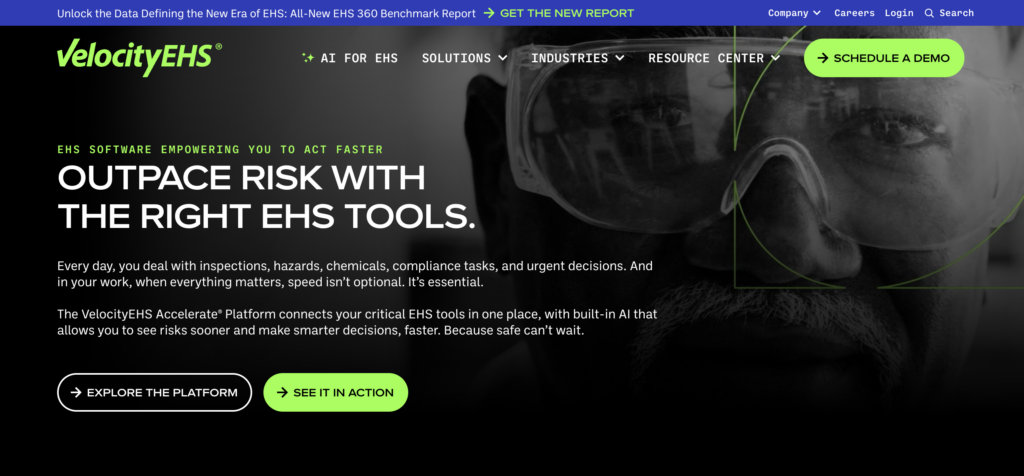
VelocityEHS offers incident management as part of its Accelerate Platform, a broad suite of more than 20 EHS products. The incident module includes AI tools for description analysis, root cause identification, corrective action recommendations, and potential serious injury and fatality (PSIF) insights, alongside OSHA recordkeeping and offline mobile capture. It tends to suit large organizations that want incident data tied into a wider risk, chemical, and ergonomics program.
The trade-off is scale. Teams that need only incident management may be buying more platform, and more cost, than the problem calls for.
Recommended For
- Enterprises consolidating incident data into a wider EHS and risk platform
- Teams that want AI-assisted investigation and predictive safety analytics
- Organizations with the budget and resources for a broad suite rollout
“My org uses Velocity for incident reporting/management, corrective action tracking, etc. Personally, I don’t really like it and wouldn’t use it again if I had the choice.”
– u/DiminishingSkills, r/SafetyProfessionals
3) Intelex
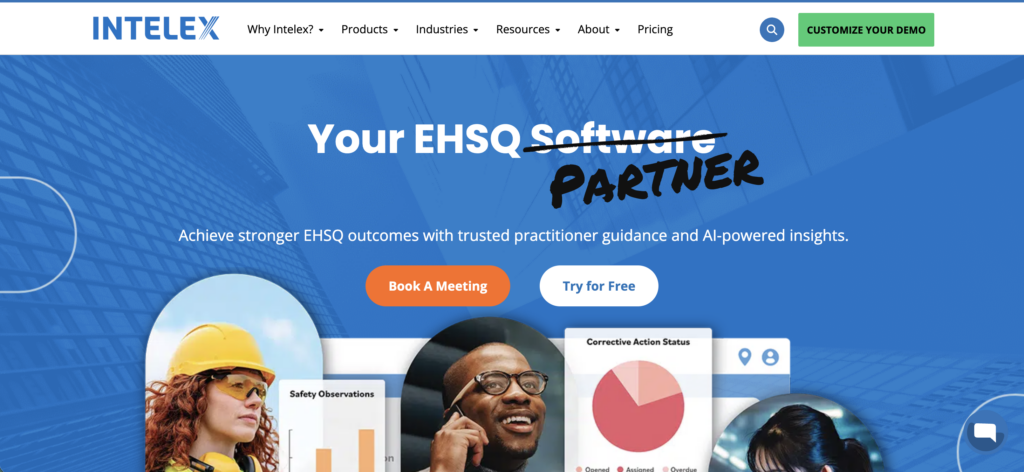
Intelex provides a dedicated incident management application within its EHSQ platform, with structured investigation workflows, multiple root cause methods, CAPA tracking, customizable forms, and automatic calculation of safety metrics such as TRIR, DART, and LTIR. It generates OSHA-ready reports and is used across more than 1,400 organizations.
It is highly customizable, though users report that some configuration changes still route back through the vendor rather than being self-service.
Recommended For
- Regulated industries needing audit-ready documentation across functions
- Multi-site companies standardizing incident capture and investigation
- Teams that want auto-calculated safety metrics built into reporting
“We eventually went with Intelex as their sales pitch was fantastic but when it came time to configure, a lot of the functionality was off”
– u/Kirbacho, r/SafetyProfessionals
4) Cority
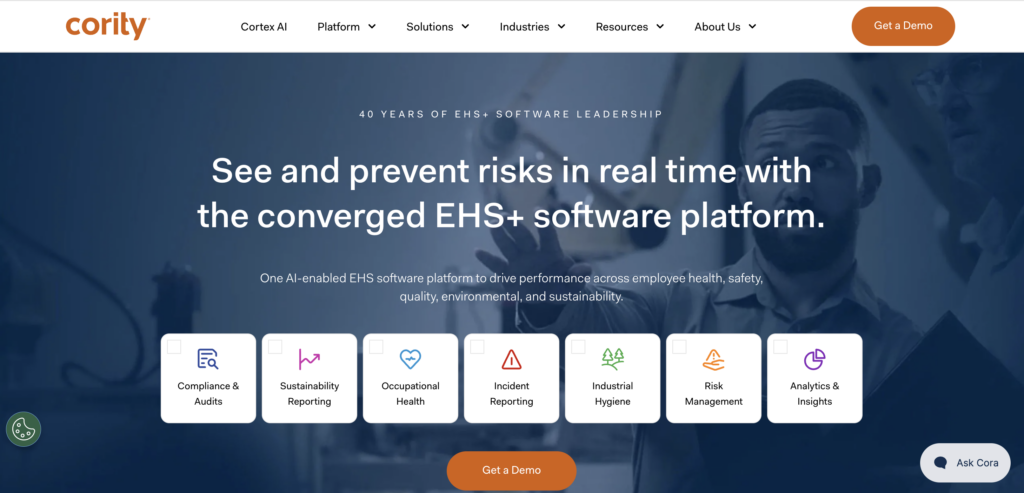
Cority delivers end-to-end incident reporting, investigation, and corrective action tracking as part of its “EHS+” platform, which extends into occupational health, environmental, quality, and sustainability. Its Cortex AI features assist with data capture and investigation, and the myCority mobile app supports field reporting. It is a common choice for large, regulated enterprises.
That breadth comes with setup effort and a learning curve that smaller teams should weigh.
Recommended For
- Enterprises that want incident management alongside occupational health and environmental workflows
- Large programs needing deep reporting and cross-functional structure
- Teams responsible for sustainability and quality in addition to safety
5) Sphera
Sphera approaches incident management through an operational risk and process safety lens, strongly associated with oil and gas, chemicals, and other asset-intensive industries. Its SpheraCloud First Report portal lets the entire workforce report incidents, near misses, and observations without a login, and the platform supports investigation, root cause analysis, corrective action, and company-wide action tracking and remediation.
Recommended For
- Asset-intensive process industries prioritizing operational risk control
- Companies that want broad, low-friction frontline reporting
- Programs where traceability and audit readiness are top priorities
6) Benchmark Gensuite
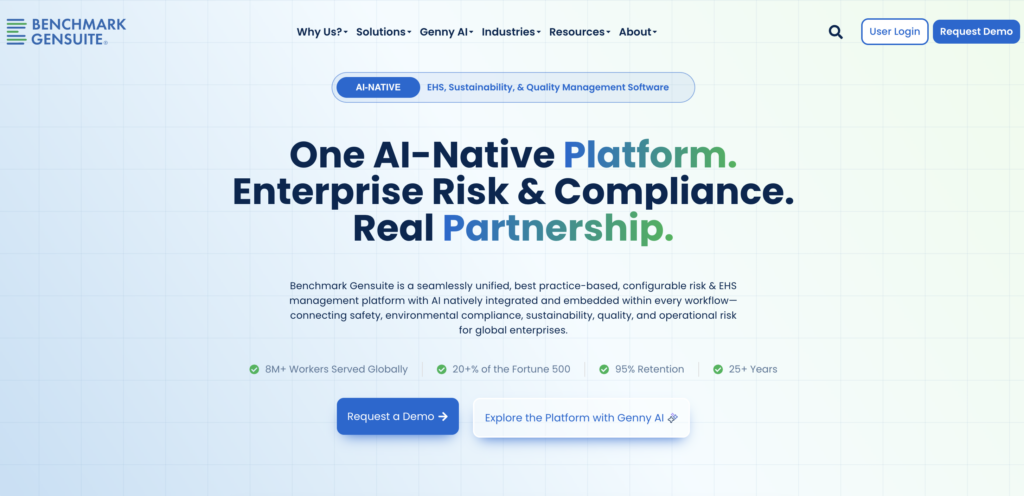
Benchmark Gensuite offers incident management within a unified EHS suite built on a single architecture, with integrated investigation, causal analysis, and corrective and preventive action tracking, plus OSHA injury and illness recordkeeping. It is mobile and offline capable with AI-assisted image capture, and is purpose-built for large and upper mid-market operations in chemicals, pharma, automotive, food and beverage, and similar industries.
Recommended For
- Enterprises and upper mid-market teams wanting incident management inside a broad EHS suite
- Multi-site operations needing standardized reporting and analytics
- Teams that value rapid deployment and strong mobile adoption
“Stuck with Benchmark and I’m jealous of customization. Having to deal with a business development team and spend “hours” that I’ve repurchased to make changes drives me insane”
– u/thebite101, r/SafetyProfessionals
“I’ve only ever used gensuite and it is way more complicated than it needs to be.”
– u/Soft_Welcome_391, r/SafetyProfessionals
7) Enablon
Enablon, part of Wolters Kluwer, provides enterprise-scale incident management within an integrated risk, EHS, and operational controls platform. It emphasizes preventing and predicting incidents, links incident and audit data to permit-to-work and process safety, and offers the Enablon Go mobile app for field reporting of events, near misses, hazards, and observations. It is used by large companies across many countries.
Recommended For
- Complex, global enterprises needing formal governance and risk frameworks
- Companies aligning incident data to executive-level risk reporting
- Programs requiring oversight across many sites or business units
“My previous employer had to budget about $200k per year to maintain Enablon. That’s not counting the yearly subscription fee.”
– u/NorCalMikey, r/SafetyProfessionals
8) SafetyCulture
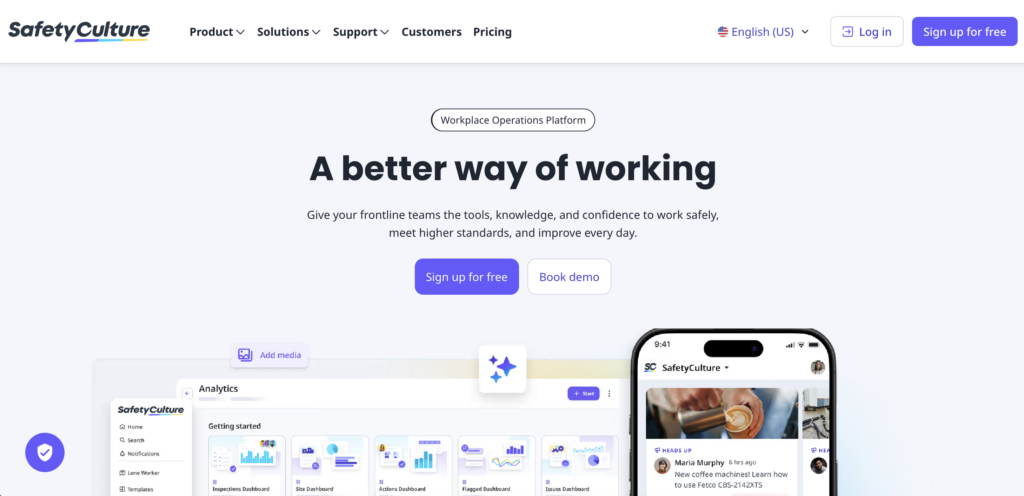
SafetyCulture (formerly iAuditor) is a mobile-first operations platform that handles incident reporting, inspections, corrective actions, and safety observations through customizable forms and a large template library. Teams often pick it when speed of deployment and frontline mobile adoption matter most.
It is lighter and faster to deploy than a full EHS suite, with less depth on formal investigation and regulatory recordkeeping.
Recommended For
- Teams that need rapid rollout and strong mobile adoption
- Operations digitizing incident capture and inspections quickly
- Companies that want simple reporting without heavy configuration
“We use Safety Culture and its terrible… constant server errors, in app photo system never works (have to take the photo on the tablets camera then upload to SC), its very basic in its utility, we constantly have something that flags up as an issue in the checks because of how the system works.”
– u/Delicious_Jacket_338, r/SafetyProfessionals
9) Ecesis
Ecesis offers a dedicated incident management product within a broader EHS platform, supporting mobile incident reporting, investigation, corrective action tracking, automated reminders, and OSHA-aligned recordkeeping with a full audit trail. Because it sits inside a wider EHS system, incident management can run alongside inspections, chemical inventory, and training.
Recommended For
- Companies that want incident management within a broader EHS platform
- Teams seeking automated reminders and a complete audit trail
- Mid-market operations that value EHS-specialist support
10) EHS Insight
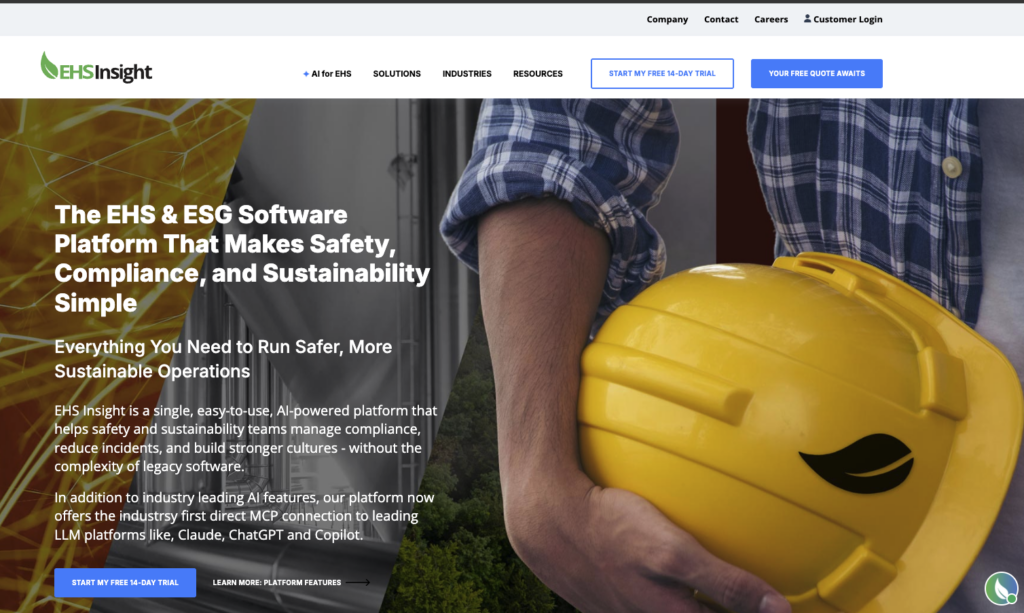
EHS Insight provides an incident management module with customizable workflows, mobile reporting with offline access, built-in root cause analysis, corrective and preventive action management, and OSHA 300, 300A, and 301 support. It also captures environmental incidents such as spills and releases, and is positioned for quick setup across small to mid-sized programs.
Recommended For
- Mid-market teams that want a configurable system with a fast start
- Programs that need both safety and environmental incident capture
- Organizations digitizing incident tracking without a large IT lift
How to Choose the Right Incident Management Software in 2026
Most software evaluations stall because teams compare feature lists before agreeing on what drives risk and cost in their operation. A better first step is to answer a few questions together as a team.
1. Do you need formal investigation and regulatory recordkeeping, or lightweight reporting?
If you are regulated under OSHA and EPA and run structured investigations with root cause analysis and 300/300A/301 recordkeeping, prioritize purpose-built systems (Frontline Data Solutions, VelocityEHS, Intelex, Cority, Enablon). If you mainly need fast frontline capture, a lighter tool such as SafetyCulture may be enough.
2. How much do you need to configure, and who pays for it?
If your forms, incident types, and workflows change often, prioritize platforms that let your own team reconfigure without paying the vendor for each change (Frontline Data Solutions, EHS Insight, Intelex). Over a multi-year horizon this is a meaningful cost difference and a common reason teams switch.
3. Who has to use it every day?
If the answer is the field, mobile and offline capture and simple action-item reminders matter more than enterprise reporting depth. If it is a small EHS or admin team, prioritize scalable investigation routing, CAPA tracking, and audit-ready exports.
4. Are you buying incident management, or a broad EHS suite that happens to include it?
Some platforms lead with incident and action tracking; others fold it into a wide EHS or operational-risk suite. Match the platform to the kind of risk you are managing, not to feature count.
The Bottom Line
No single platform wins for every organization. The right pick comes down to your regulatory exposure, how much you expect to reconfigure the system over time, and who uses it day to day. If you are mid-market and tired of paying for every change, weigh total cost of ownership and how much you can configure in-house against raw feature count, and talk to reference customers in your own industry before you commit.