


Written By:
Tiffany Gurary
Tiffany is an EHS professional with 15 years of experience supporting chemical manufacturing, research and development, pilot operations, and multi-site industrial environments.
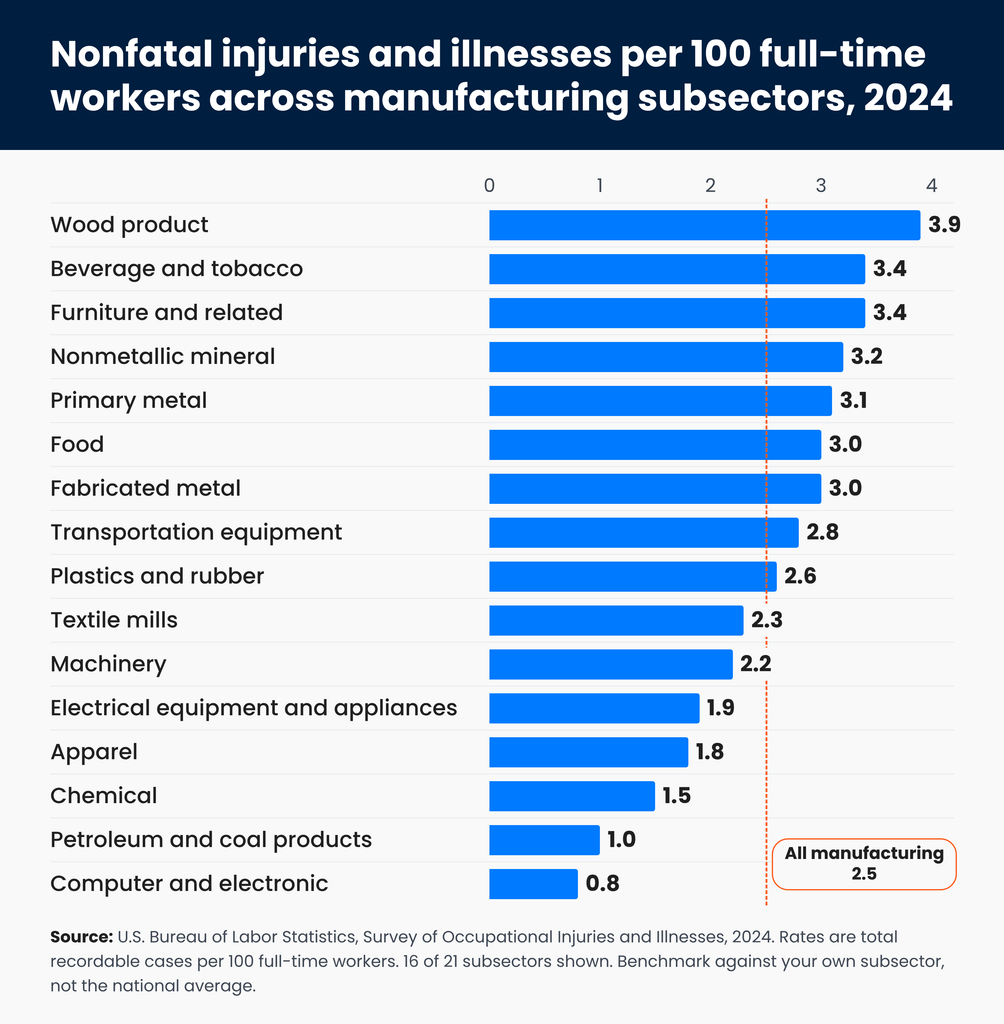
Factory safety keeps people from being hurt by machines, materials, vehicles, and anything else in the work environment. The best factory safety strategy works on hazards first; guards machines and locks out energy next; and PPE last. Manufacturing employers reported 306,500 nonfatal injuries and illnesses in 2024, or 2.5 cases per 100 full-time workers.
I’ve led EHS across manufacturing facilities, and these are my safety tips based on OSHA’s standards and the most common injuries. Let’s start with why factory safety is so important.
What factory safety covers
Four sources of harm cause most floor injuries: machines and stored energy, materials and chemicals, moving equipment and people, and physical environment. To define a few terms before we use them:
- A hazard is the source of harm
- Risk is how likely and how severe that harm is
This guide covers the whole program.
How common are factory injuries?
Injury rates vary almost fivefold across manufacturing, so benchmark against your own subsector rather than the national average. Here are the subsectors’ cases:
| Subsector | Cases per 100 full-time workers in 2024 |
| Wood product manufacturing | 3.9 |
| Food manufacturing | 3.0 |
| Transportation equipment | 2.8 |
| All manufacturing | 2.5 |
| Chemical manufacturing | 1.5 |
| Computer and electronic products | 0.8 |
The National Safety Council estimates medically consulted work injuries average about $48,000. The most serious outcome is thankfully also the least common: 355 manufacturing workers died on the job in 2024, and contact with objects and equipment was the leading cause a 105 deaths.
OSHA requirements for every factory
OSHA’s General Duty Clause requires no recognized serious hazards in the workplace. These are the serious hazards:
| Machine guarding (1910.212) | Guards that protect operators from machine hazards | Guards secured in place? |
| Lockout/tagout (1910.147) | Written procedures; annual inspection, certified | Procedure at the machine? |
| Hazard communication (1910.1200) | Labels, safety data sheets, training | Every container labeled? |
| Respiratory protection (1910.134) | Written program, fit testing, training | Fit tests current? |
| Powered industrial trucks (1910.178) | Trained operators, evaluated every three years | Evaluation dates on file? |
| Hearing conservation (1910.95) | Program at 85 decibels over eight hours | Noise survey current? |
| Walking-working surfaces (1910.22) | Clean, dry, hazard-free, regularly inspected | Spills and clutter cleared? |
| Injury recording and reporting (29 CFR 1904) | Log recordable cases; report a death within 8 hours, a hospitalization, amputation, or eye loss within 24 | Who files the report? |
2026 maximum penalties are $16,550 per serious violation and $165,514 per willful or repeated violation. That’s a hefty fine on top of the average cost of an injury.
Top 12 factory safety tips
The hierarchy of controls, from NIOSH, ranks protections from most to least effective: eliminate a hazard, substitute something safer, engineer the hazard out of reach, change how people work, and only then focus on protecting the person. Controls near the top don’t depend on anyone remembering anything, and that’s why they’re our first line of defense.
Remove or replace the hazard
1. Review changes before they happen.
Do a design-stage review before changing a process, and that includes installing new equipment. Hazards are easiestt to remove on paper. Check that every change has a documented review and sign-off.
2. Substitute safer materials.
Use a less hazardous chemical where you can keep labels and SDS current (1910.1200). Fewer hazardous materials means fewer exposures to manage. Check every container is labeled and every SDS is on file.
Engineer the hazard out of reach
3. Keep guards on.
OSHA’s standard says machine guards have to protect the operator and be secured in place (1910.212). A guard that’s routinely removed is no guard at all. Check that operators confirm guards and emergency stops work before each shift.
4. Lock out hazardous energy.
Write machine-specific lockout procedures (1910.147) and inspect them at least annually. Check that your procedure is posted at the machine and the last inspection is dated.
5. Separate people from forklifts.
Mark pedestrian routes, evaluate each operator at least every three years, and retrain after an accident, near miss, or unsafe operation (1910.178). Check evaluation dates are filed and accurate.
6. Prevent noise and bad air at the source.
For noise and air, enclose loud machines and ventilate fumes before relying on earplugs and respirators. Hearing conservation has to start at 85 decibels averaged over eight hours (1910.95). Check your noise survey is current since that changes with new processes and pieces of equipment.
Change how the work is done
7. Keep floors clear.
Surfaces should be clean, dry (if possible), free from spills and loose boards, and inspected often (1910.22). Check that spills are cleaned during the shift.
8. Drill your emergency plan.
Keep a written plan, review it with your team and keep exits unblocked (1910.38). Inspect extinguishers monthly and service them annually (1910.157). Check the last drill date.
9. Require permits for non-routine work.
Hot work needs authorization, a cleared area, and a fire watch (1910.252). Permit-required confined spaces need an entry permit (1910.146). Check that if there’s no permit, there’s no work.
10. Use ergonomics and prevent heavy lifting.
OSHA has no ergonomics standard, but it can cite strain hazards under its General Duty Clause. Rotate tasks and use lift aids. Check your top five strain tasks are listed someone owns them
11. Maintain equipment on schedule.
If you skip maintenance, that’s how guards, interlocks, and relief devices fail. Track inspections and close the findings. Check no inspection is overdue.
Protect the person
12. Use PPE as the last line.
Determine hazards, certify the hazard assessment in writing, provide PPE, and train employees to use it (1910.132). Check the hazard assessment is current for every job.
A daily-to-annual hazard check routine
Our tips only work when you create a habit out of them. I put together this rhythm to make them a routine.
| When to check | What to check |
| Before each shift | Guards are in place, emergency stops are tested, aisles and exits are clear |
| During the shift | Spills are cleaned, pedestrian routes are respected, unsafe conditions are reported |
| Weekly | Near-miss reports are reviewed, open corrective actions are chased |
| Monthly | Extinguishers and exits are inspected, housekeeping walk is completed |
| Quarterly | Safety committee review, emergency drill, injury trend check |
| Annually | Lockout procedures inspected and certified, hearing and training refreshers, emergency plan reviewed |
Training and onboarding for factory safety
If your workers don’t know the safety processes, no safety program is going to work.
Walk every new hire through safety orientation before using equipment, then complete task-specific training before each new task.
To keep training fresh, retrain after a near miss, anything a worker’s done that’s unsafe, new equipment, or a change in procedure. Keep a record of who was trained, when, and by whom. This is training tracking, and it’s routine but important!
Reporting, near misses, and incident response: Using these for safer sites
If you keep on top of the 12 safety tips, you’ll run into drastically less incidents. But incidents are always going to happen because we can’t spot everything, as hard as we try.
When someone is hurt, this is the step-by-step to triage:
- Be sure the area is safe and the issue won’t reoccur
- Get medical care.
- Preserve the scene and notify your supervisor.
- Report to OSHA if it’s required: a fatality has to be reported within 8 hours, and an in-patient hospitalization, amputation, or loss of an eye within 24 hours.
- Record the case if it meets OSHA’s recording criteria and start an investigation.
Investigate near misses too because those are crucial to fix. Give every corrective action an owner and a due date. Make reporting easy and free of blame because near misses can become incidents.
Measuring factory safety
We have a lot of data. The trouble is using it because we’re usually working on paper, different software tools, or spreadsheets.
Track TRIR (in other words, your recordable cases multiplied by 200,000, divided by hours worked). That equals cases per 100 full-time workers, so you can compare it with the BLS table above.
For example, 5 cases over 400,000 hours is a TRIR of 2.5. Track DART, the rate of cases with days away, restricted duty, or transfers, the same way.
Then, add three leading indicators: percent of corrective actions closed on time, near-miss reports per 100 employees, and inspection completion rate. TRIR is after the factor, so get leading indicators too.
Five common factory safety mistakes
The most common mistakes I see with factory safety aren’t deliberate. They’re usually because we have small teams trying to secure safety for several sites. These could be some of your blindspots if that’s you.
- Starting with PPE. PPE is the weakest control. Go for elimination, guarding, and write procedures first.
- Removing guards to cut corners and save time.
- Writing lockout procedures once. Procedures are going to change with how people use your machines.
- Treating near misses as nonevents. Unreported near misses hide the next injury.
- Keeping records in five places. Files scattered across spreadsheets are hard to find when an auditor asks.
Paper and spreadsheets don’t work anymore
You’ve got three warning signs that a legacy tracking system is lagging: corrective actions nobody owns, equipment changes made without review, and training expirations found at audit. It’s time to think about using software to manage your safety program.
We helped LED manufacturing company Optec with their action tracking. Lynn Benishek, Director of Operations at Optec LED Lighting, said it’s improved how they manage logs:
Our team members log everything—from daily checks to monthly audits. Because recurring tasks are assigned automatically, team members never forget.
Frontline ACT assigns, tracks, and closes corrective actions, so findings from your daily checks do not stall.
Safety Software pricing
Pricing Simplified.
Visit our pricing page to get a fast quote before you talk to sales.
Factory safety FAQ
What is factory safety?
Factory safety is the controls, routines, and habits that stop workers from being hurt by everything from machines, materials, vehicles, and the general work environment.
What are the most common factory injuries?
The most common factory injuries are overexertion, contact with objects and equipment, and the infamous slips, trips, and falls.
What are the most important factory safety rules?
Keep guards on, lock out energy before servicing, keep floors clear, wear the right PPE, and report hazards immediately.
Which OSHA standards apply to a factory?
Commonly machine guarding, lockout/tagout, hazard communication, respiratory protection, powered industrial trucks, and noise. See the table above.
How often should factory safety inspections happen?
Daily operator checks, weekly and monthly reviews, and annual lockout procedure inspections. See the routine above.
How do you measure factory safety?
Track TRIR and DART, plus leading indicators such as on-time corrective actions and near-miss reports.