
Written By:
Tiffany Gurary
Tiffany is an EHS professional with 15 years of experience supporting chemical manufacturing, research and development, pilot operations, and multi-site industrial environments.
Cority is a large player in the EHS software space. It boasts hundreds of customers and positive G2 reviews. If you’re shopping for safety software, Cority will come up, and it’s even in our EHS software recommendations.
But Cority has a dated interface, high clicks per task, high cost, and complex setup. Midmarket teams of 50 to 1,000 employees that want simpler use have good options.
Because no platform is perfect for every single safety team, my entries below say who the platform fits. We make Frontline, and we list it first because it fits a specific profile: multi-site manufacturers and process-industry teams.
Why do people look for Cority alternatives?
Cority has a suite of safety tools in a unified platform. On G2, Cority has a 4.0 from 81 reviews, and users say it takes an average of five months to onboard and ten months for ROI. Cority doesn’t publish their prices.
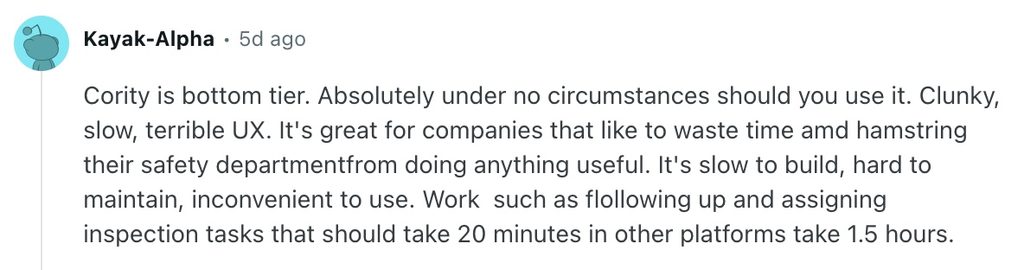
Customers have their struggles with enterprise EHS software: its bloat, its complicated setup, its high costs. Comments like this one on Reddit aren’t uncommon when buyers walk into Cority unprepared:
When is Cority still the right choice?
If you run a big regulated program and need everything from occupational health, industrial hygiene, and ESG reporting in one place (and you have the budget and time for the multi-month rollout), Cority has the breadth and depth to make your shortlist.
My alternatives below have tradeoffs that make them better for midmarket companies: they’re simpler and have faster time to ROI.
How we chose our seven alternatives
I looked for EHS platforms that:
- Work with companies around 50 to 1,000 employees
- Cover the essentials of EHS (such as incidents, audits, corrective actions, and training)
- Have public reviews on G2 and customer references I can cite
I left out enterprise heavy platforms. For instance, Octave Reliance (aka ETQ Reliance), has their listing warn against users from companies under 500 employees, and most of the Benchmark Gensuite reviewers on Capterra are enterprise. My sources are G2 and Capterra stats as of October 2026.
Cority Alternative Quick-Look Comparison Table
Here’s the TL;DR:
| Platform | Best for | Rating (source, reviews) | Setup time | Pricing |
| Frontline | Multi-site manufacturing, oil & gas, and chem process industries; midmarket safety professionals | G2 4.2 (16) | 90 days | Quote; a la carte by module |
| EHS Insight | Small and mid-sized teams starting with core EHS | G2 4.6 (83) | 4 months | Per user and module; free trial |
| VelocityEHS | Safety, ergonomics, chemical, and risk | G2 4.4 (186) | 2 months | Not published; free trial |
| Mitti (by SafetyCulture) | Frontline inspections, audits, and actions | G2 4.6 (482) | N/A | Per user |
| Novara (formerly KPA) | Training-heavy mid-market programs | Capterra 4.8 (130) | 3 months | Custom quote only |
| HSI | Training-led safety and compliance | G2 4.6 (65) | 4 months | Custom; 1 to 5 year contracts |
| EcoOnline | Chemical management and safety compliance | Capterra 4.6 (123) | 3 months | Custom quote only |
| Cority (for reference) | Large, regulated programs | G2 4.0 (81) | 5 months | Not public |
The 7 best Cority alternatives
1. Frontline

Frontline Data Solutions has customers mainly in manufacturing, chemical, and oil and gas teams with several sites who want to pay only for the modules they need. However, Frontline also works with companies in energy, construction, transportation, and many more listed on the industries page.
On G2, reviewers rate Frontline EHS 4.2 out of 5 and score ease of admin and quality of support at 9.2 out of 10, ahead of VelocityEHS’s 8.5 and 8.7 in G2’s side-by-side.
Strengths: Frontline covers four modules:
- Training (LMS)
- Change management (MOC)
- Incident and corrective actions (ACT)
- Contractor safety (CSM)
Modules can be bought individually, and setup, training, and support are included in the price. The company maintains a go-live date for their clients within 90 days, which is faster than most EHS tools.
Frontline also has a mobile app that supports workers in the field.
2. EHS Insight
EHS Insight is for companies that want their incidents, corrective actions, audits, compliance tracking, and training in one subscription. They have customers predominantly in oil and energy, chemicals, manufacturing, mining, and construction.
EHS Insight has a 4.6 out of 5 with 83 reviews on G2. Reviewers score quality of support 9.2 out of 10 and ease of admin 8.8, and they name ease of use and customization as top positives.
Ease of setup is lower at 7.7, and G2 users report about four months to implement. EHS Insight has a mobile app that makes inspections from a phone easy.
Expect about four months to go-live.
Strengths
- Setup is self-service and doesn’t need professional services (though, depending on whether this holds true or not, this may be a con)
- Built-in support for U.S. OSHA 300 and 301 recordkeeping
- Incidents, corrective actions, permits, inspections, and safety data sheets are all in one system
3. VelocityEHS
VelocityEHS sells software for safety, ergonomics, environmental compliance, control of work, and ESG. They have thousands of customers who are mostly in manufacturing, food and beverage, pharmaceuticals, and chemicals.
VelocityEHS has a 4.4 out of 5 from 186 reviews on G2. Ease of use is the most cited positive followed by intuitiveness. But the most cited negatives are a confusing interface and difficult navigation. Its navigation and submodules can be hard to quickly locate. It runs a little closer to Cority in that the number of modules overwhelms new users and simple tasks take many clicks.
G2 users say it takes an average of two months to implement, but only seven reviewers said that.
Strengths
Its two-month implementation average is quick, though the sample is small.
The one platform has safety, ergonomics, chemical management, and risk, so a team can start with one module and add others.
4. Mitti (by SafetyCulture)
SafetyCulture rebranded as Mitti this year. The company has over 80,000 clients who use it.
Mitti is closer to an OH&S tool than an EHS suite. Pricing is per user, so cost rises with headcount, and some reviewers want deeper analytics.
G2 shows 4.6 out of 5 from 482 reviews, which is the largest review base on this list. It’s got mobile inspections, templates with action triggers, and the step from an inspection finding to an assigned corrective action on the same device.
Be mindful that all users can see the issues section, and cost grows per seat (including paid accounts for contractors).
Strengths
Incident reporting connects to corrective actions, and a training module is included.
Inspections and audits run from a phone, and customizable templates trigger actions based on the answers.
5. Novara (aka KPA)
KPA focused on EHS and compliance for 40 years, and it just separated its Flex and Risk Management Center division into a new company, Novara, in 2026. Novara focuses on safety management and operational risk in manufacturing, construction, utilities, and oil and gas.
Capterra 130 reviews on Capterra, Novara has a 4.8. with ease of use at 4.7 and customer service at 4.8. On G2 it has 4.6 from 83 reviews, and reviewers split between mid-market, about 48 percent, and enterprise, about 40 percent. Of all the choices on the list, this might be one closer to Cority in size and scale, so watch out for this. Complaints include some similar to Cority: workflows that are hard to build and difficulty in navigation.
Strengths
- Training management, incident reporting, workflows, digital job safety analyses, asset tracking, and a mobile app on one platform.
- Reviewers cite flexible form building, quick configuration, and computer-based training with employee acknowledgements.
6. HSI
HSI, the Health & Safety Institute, is a family of EHS brands covering everything from emergency care to workplace safety training, tracking and reporting, and chemical inventory management. Now, HSI sells an all-in-one EHS platform.
HSI has a 4.6 and 65 reviews G2; most of those reviewers are midmarket. G2 users say it takes about four months to onboard and about 17 months to see a return, and reviewers rate its cost at the top of G2’s scale.
Expect add-on prices for features like GPS.
Strengths
- Permit to work, contractor management, and a regulatory compliance calendar sit alongside the incident and training modules.
- The LMS assigns training by location, role, or task, supports SCORM and HSI’s course catalogue, and tracks certification expiry.
7. EcoOnline
EcoOnline was founded in Norway as chemical engineering software. In 2023, EcoOnline merged with the software division of Alcumus. Since then, EcoOnline covers a chemical inventory and searchable SDS library. It’s got chemical risk assessment, audits and inspections, incident management, an LMS, ESG reporting, and a lone worker app.
EcoOnline holds 4.3 and 44 reviews on G2. Its suite has centralized training, inspection, incident, and document records across branches. You can handle same-day incident and near-miss reporting from job sites with photos and send forms that route to several stakeholders.
Strengths
- EcoOnline was made for the chem industry. It’s got a central SDS library, searchable chem inventory, and guided risk assessments.
- EcoOnline says it covers more than 80 countries and jurisdictions.
How to Switch from Cority
Enterprise platforms are difficult to migrate off by design. The more stake you have in the platform, the harder it is to cancel your contract. You have to keep stock of these to make the switch:
- Your contract dates. Find the renewal date and the notice period. Start your evaluation process for new vendors at least six months before renewal so you aren’t forced to extend.
- Your records. Export all your incidents, audits, corrective actions, and training records, and confirm the format. OSHA requires employers to keep injury and illness logs for five years, so you’ll need your history.
- Your configuration. List the custom forms, fields, workflows, and reports you rely on.
- Your rollout order. Pilot one site or one module first. Run the old and new systems side by side for a short period, then move the remaining sites in waves.
See how Frontline fits your sites
Bring your site count, know the modules you need, and come with questions. In our demo, you can judge scope and timeline for yourself.