


Written By:
Monica Kinsey
Monica is a former warehouse operations manager with 7 years of experience in process safety and workplace operations. She has a BS in Logistics, Materials, & Supply Chain Management.
Management of change (MOC) is a process for reviewing and documenting changes to equipment, processes, materials, procedures, or personnel before they happen. MOC makes sure the change doesn’t create new safety risks.
In business, making swift changes without a plan is often a recipe for disaster. And while you might succeed with this strategy in the short term, it’s better to consider how changes might affect your company’s performance if they don’t pan out the way you pictured. Below, I share some of the top reasons why you need change management in the workplace.
Free Template!
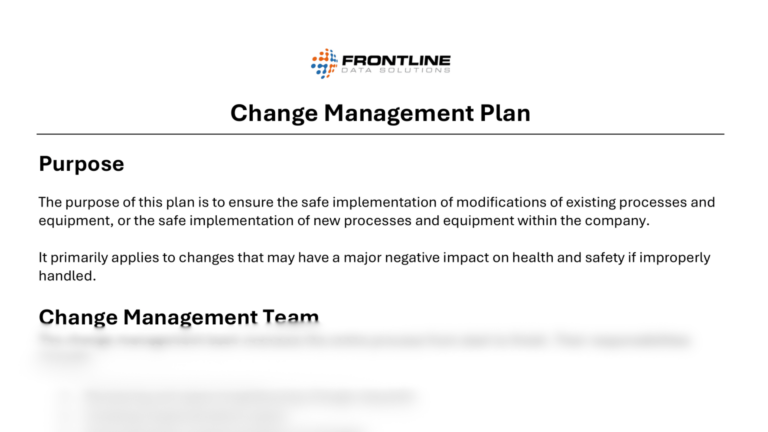
Download this free change management plan template to get started at your site.
What is Management of Change?
Management of change is the process of carefully evaluating and controlling modifications to equipment, processes and people so they don’t have an adverse impact on safety, quality or productivity.
Some examples of changes that might go through the change management process include:
- Installing a brand new, potentially hazardous piece of machinery
- Restructuring the personnel hierarchy within your company
- Adding a new step to a process
- Changing the PPE requirements for a work area or position
- Switching suppliers for critical equipment components
A good MOC process asks this: What’s changing and why? What hazards would it introduce? Who needs to approve it? What has to be updated first? Once those answers are documented, work begins with clear owner and record.
Change management in the workplace involves careful consideration of all the effects that a change might have on safety, quality, and productivity. And the introduction of this process can have major benefits for overall company performance.
Management of change vs. change management
The two terms are related but not interchangeable. MOC focuses on finding and controlling safety and operational risks a change might create. On the other hand, organizational change management focuses on helping people adopt a change through communication and training. Most workplaces need both, but this post covers management of change, the risk-control side.
Why Management of Change Matters
For facilities that handle highly hazardous chemicals, management of change isn’t optional. OSHA’s Process Safety Management standard (29 CFR 1910.119(l)) requires written procedures to manage changes to process chemicals, technology, equipment and procedures. EPA’s Risk Management Program rule has a matching requirement at 40 CFR 68.75. ISO 45001 (clause 8.1.3) also expects organizations to plan how they’ll manage changes that affect their safety performance.
If your operation isn’t covered by PSM or RMP, MOC is still a best practice. That’s because the failure pattern is the same everywhere: unreviewed change creates a hazard nobody planned for.
That’s why the benefits below matter.
1. Reduce Operational and Safety Risks
While all businesses have risk exposure, change management helps reduce those risks in several ways. When you make changes too quickly, you run the risk of wasting resources. From wasted time to unnecessary rework, there are so many areas where you might be spending more than you need to. But if you carefully plan out and make changes, you can avoid many of these costs.
Another major area of risk reduction is in safety. This is especially true when you’re introducing dangerous equipment or modifying hazardous processes. You need the change management process to make sure workers are safe once the changes go into effect.
Process safety has a history that shows its importance. In 1974 at a chem plant in Flixborough, England, a pipe installed to bypass a damaged reactor didn’t get a full engineering review. This led to an explosion that killed 28 people, hence modern MOC requirements. Most changes are smaller than that, but routine changes are usually the ones that go unchecked.
2. Audit Readiness
Documented MOC gives proof that your team approved changes. That’s what auditors and inspectors ask to see. Documented MOC includes requests, risk assessments, approvals, and completed actions, so you have all documents in one place for an audit.
For PSM- and RMP-covered facilities, MOC records show that changes were reviewed affected procedures were updated. They prove employees were informed or trained before startup.
3. Finish Projects More Efficiently
Another benefit of change management in the workplace is that it can help you finish projects more efficiently. Consider this: how many projects have you started at work and then abandoned?
Change management helps you avoid this by:
- Requiring changes to go through an approval process before work starts
- Implementing a series of checks to ensure everything’s implemented correctly
- Documenting the entire process from start to finish
Because you won’t have to worry about creating a new approach for each project, you can spend more time completing action items. That means that your projects are more likely to stay on schedule.
4. Improve Team Organization
Lack of organization can kill new initiatives within a company. Change management provides a structured process that keeps your team on track. This is especially true if you use management of change software, like Frontline MOC, to coordinate everything. That’s because software systems make it easy to assign and track action items for everyone on the team. That way, you don’t have to manually oversee every element of a project by hand.
5. Avoid Redundancy, Unplanned Downtime, and Rework
Documenting change management in the workplace can help avoid redundancies and rework. Oftentimes, people within a company try to solve a problem with the same approach that someone else already tried unsuccessfully. This often results in redundant failures.
But if you carefully manage changes and document your efforts, you’ll have a thorough record of all attempts to solve a problem. That way, you can avoid implementing a change that failed the last time around. Or you can modify the previous attempt so that you don’t have to rework the problem after implementation.
Undocumented changes are a common cause of unplanned downtime. When nobody knows a component was swapped, troubleshooting takes longer.
6. Lasting Change Management in the Workplace
The last, but certainly not least, benefit of change management is that it helps you make meaningful improvements to your company’s performance. Because it requires you to approve changes before you start working on them, you’ll be more selective with how you use your resources.
Overall, implementing change management in the workplace is an important step in transforming how your company operates. If you do it correctly, you’ll be able to reap the benefits for years, and hopefully decades, to come.
Getting these benefits with MOC software
You can run an MOC process on paper forms or spreadsheets, but it can slow you down. Paper trails get lost. Here’s how paper compares to digital software:
| Paper and spreadsheets | Management of change software | |
|---|---|---|
| Approvals | Routed by email or hand | Routed automatically with reminders |
| Visibility | Status is visible to whoever holds the form | One view of every open change |
| Action items | Tracked separately (if they’re tracked) | Assigned and tracked to completion |
| Audit trail | Has to be reconstructed after the fact | Kept as changes move through review |
Frontline’s management of change software digitizes MOC with action items tracked alongside them. Customers see the difference in day-to-day work.
Want to put management of change into practice? Download the free management of change plan template to outline your process, or request a free demo to see how Frontline MOC helps you manage changes from request to close-out.
Management of change FAQ
What are the benefits of management of change?
The main benefits of management of change are reduced safety and operational risk, stronger regulatory compliance and audit readiness, less unplanned downtime and rework, more efficient projects, and clearer accountability.
Is management of change the same as change management?
No. Management of change identifies and controls the safety and operational risks a change could create. Organizational change management helps people adopt a change through communication and training. Many teams use both.
Is management of change required by OSHA?
Facilities covered by OSHA’s Process Safety Management standard must have written MOC procedures under 29 CFR 1910.119(l). Facilities outside PSM may not be required to have one, but MOC is widely considered a best practice. [confirm]
What types of changes require management of change?
Changes to equipment, chemicals and materials, process steps, procedures, control systems, PPE requirements, suppliers, and staffing or roles can all trigger a review. A replacement that is identical to what it replaces (“replacement in kind”) is typically exempt, so define that term clearly in your own procedure.
What happens if you skip management of change?
Unreviewed changes can introduce hazards nobody planned for, lead to equipment damage and unplanned downtime, and leave you without the documentation auditors expect. The most common mistake is completing MOC paperwork after the change has already been installed, which defeats its purpose as a control.